(104) HEADSHIP OF A MUTT
Prev Next
5th April, 1947
[* A Mutt/Math is an independent monastary.]
The same devotee who questioned Bhagavan yesterday about human effort in the individual’s action, today told him about his ill health, treatment by doctors and services rendered to him by his servants and said, “Swamiji! We are unable to keep this body of ours in good condition and so entrust it to the care of doctors and servants. When the body itself is not under our control, what is the use of people talking of reforming the world?” Do you know that for the last five or six months Bhagavan is not allowing anybody to touch his legs or massage them with oil, and that he himself does it whenever necessary? Hence he did not reply to the devotee’s question immediately, but in the evening, when the devotees all gathered, he began massaging his legs with oil, and looking at the questioner with a smile, said, “We are our own doctors and our own servants.”
Again the questioner said, “What are we to do if we do not have strength like Bhagavan’s to attend to our own work?”
Bhagavan’s reply was, “If we have the strength to eat, why should we not have the strength to do this?” The questioner could not say anything and so kept silent with bent head. Just then the post arrived. After looking through the letters, Bhagavan began narrating as follows:
“Once a certain sannyasi was anxious to be the head of a mutt. He had to have disciples, you see. He tried his level best to secure some. Any one who came, soon found out the limited knowledge of the person and so went away. No one stayed on.
What could he do? One day he had to go to a city. There he had to keep up his position, but he had no disciple. ‘No one must know this’, he thought. His bundle of clothes was on his head. So, he thought he would place the bundle in some house unobserved and then pretend to go there afterwards. He wandered throughout the place. Whenever he tried to step into a house, he found a number of people in front of it. Poor chap! What could he do? It was almost evening. He was tired.
At last, he found a house with no one in front. The door was open. Greatly relieved, he placed the bundle in one corner of the house and then sat in the verandah. After a while the lady of the house came out and enquired of him who he was. ‘Me! I am the head of a mutt in such and such a place. I came to this city on some work. I heard that you were good householders. I therefore sent my belongings through my disciple to put them in your house, thinking that we could put up with you for the night and go away next morning. Has he done so?’ ‘No one has come, sir,’ she said. ‘No, please check. I asked him to put the bundle here, go to the bazar and get some things. Kindly see if he has put it in any corner,’ he said. When the lady searched the house, she saw the bundle in one corner.
Thereupon her husband and she welcomed him and gave him food and a room to sleep in. Rather late in the night, they asked, ‘How is it, sir, your disciple has not come yet?’ He said, ‘Perhaps that useless fellow has eaten something in the bazar and is wandering about. You please go to bed. If he comes, I will open the door for him.’ “That couple had, by then, understood the sannyasi’s true position. They thought they would see further fun and so went into the house to lie down. Then the person started his pretensions. He opened the door and closed it, making a loud noise so as to be heard by the members of the household.
He then said loudly, ‘Why! What have you been doing so long? Take care, if you do it again, I shall beat you black and blue. Be careful henceforth.’ Changing his tone thereafter, he said in a plaintive voice, ‘Swami, Swami please excuse me. I shall not do it again.’ Assuming the original tone, he said, ‘All right. Come here, massage my legs, here; no, there; please hit lightly with your fists. Yes, a little more.’ So saying, he massaged his own legs and then said, ‘Enough; it is rather late, go to bed.’ So saying he went to sleep. There was a hole in the wall of the room where the couple were staying and through it they saw the whole farce.
In the early morning the sannyasi again began repeating the evening’s performance, saying, ‘You lazy fellow! The cocks have begun to crow. Go to so and so’s house and come back after doing such and such work.’ So saying, he opened the door, pretended to send him away and went back to bed. The couple saw this also.
In the morning he bundled up his belongings, put the bundle in a corner, and went to a tank nearby for bathing, etc. The couple took the bundle and hid it somewhere. The sannyasi returned and searched the whole room but the bundle was not found anywhere. So he asked the lady of the house, ‘Where is my bundle?’ The couple then replied, ‘Sir, your disciple came here and took away the bundle saying you wanted him to bring it to you. It is the same person who massaged your legs last night.
He must be round the corner. Please see, Swami.’ What could he do then? He kept his mouth shut and started going home.”
Showing posts with label stories. Show all posts
Showing posts with label stories. Show all posts

Letter 86
(86) JNANA SAMBANDHAMURTHY
Prev Next
1st February, 1947
After Bhagavan had read out from the Tamil commentary of Soundarya Lahari and told us that the words ‘dravida sisuhu’ referred to Sambandha himself, the discussion on that subject continued in the Hall for the subsequent two or three days. In this connection a devotee asked Bhagavan one day, “Sambandha’s original name was Aludaya Pillayar wasn’t it? When did he get the other name of ‘Jnana Sambandhamurthy?’ and why?”
Prev Next
1st February, 1947
After Bhagavan had read out from the Tamil commentary of Soundarya Lahari and told us that the words ‘dravida sisuhu’ referred to Sambandha himself, the discussion on that subject continued in the Hall for the subsequent two or three days. In this connection a devotee asked Bhagavan one day, “Sambandha’s original name was Aludaya Pillayar wasn’t it? When did he get the other name of ‘Jnana Sambandhamurthy?’ and why?”
Bhagavan replied, “As soon as he drank the milk given by the Goddess, Jnana Sambandha (contact with Knowledge), was established for him, and he got the name Jnana Sambandhamurthy Nayanar. That means, he became a Jnani without the usual relationship of Guru and disciple. Hence, people all over the neighbourhood began to call him by that name from that day onwards. That is the reason.” I said, “Bhagavan too acquired knowledge without the aid of a Guru in human form?” “Yes! yes! That is why Krishnayya brought out so many points of similarities between Sambandha and myself,” said Bhagavan.
“In Sri Ramana Leela it is stated, that while Sambandha was coming to Tiruvannamalai the forest tribes robbed him of his possessions. He was a man of wisdom and knowledge.
What property had he?”, I asked. “Oh! that! He followed the path of devotion, didn’t he? Therefore he had golden bells and a pearl palanquin and other symbols of that nature according to the injunctions of Ishwara. He had also a mutt (an establishment for monks) and all that a mutt requires,” said Bhagavan. “Is that so? When did he get all those?” I asked.
Bhagavan replied with a voice full of emotion, “From the time when he acquired the name of Jnana Sambandha, that is, even from his childhood, he used to sing with uninterrupted poetic flow and go on pilgrimage. He first visited a holy place called Thirukolakka, went into the temple there, sang verses in praise of the Lord, beating time with his little hands. God appreciated it and gave him a pair of golden bells for beating time. From that day onwards the golden bells were in his hands whatever he sang and wherever he went. Thereafter he visited Chidambaram and other holy places and then went to a pilgrim centre called Maranpadi.
There were no trains in those days. The presiding deity in that place observed this little boy visiting holy places on foot.
So His heart melted with pity and He created a pearl palanquin, a pearl umbrella and other accompaniments bedecked with pearls suitable for sannyasis, left them in the temple, appeared to the brahmin priests there and to Sambandha in their dreams and told the Brahmins, ‘Give them to Sambandha with proper honours,’ and told Sambandha, ‘The Brahmins will give you all these; take them.’ As they were gifts from Gods he could not refuse them. So Sambandha accepted with reverential salutations by doing pradakshina, etc. and then got into the palanquin. From that time onwards he used to go about in that palanquin wherever he went. Gradually some staff gathered around him and a mutt was established. But whenever he approached a holy place, he used to alight from the palanquin as soon as he saw the gopura (tower) of the shrine and from there onwards, he travelled on foot until he entered the place. He came here on foot from Tirukoilur as the peak of Arunagiri is visible from there.” A Tamil devotee said that that visit was not clearly mentioned in Periapuranam, to which Bhagavan replied as follows: “No. It is not in Periapuranam. But it is stated in Upamanyu’s Sivabhaktivilasam in Sanskrit. Sambandha worshipped Virateswara in Arakandanallur and won the god’s favour with his verses and then he worshipped Athulyanatheswara in the same way. From there he beheld the peak of Arunagiri and sang verses out of excess of joy and installed an image of Arunachaleswara in the same spot.
While he was seated there on a mandapam, God Arunachaleswara appeared to him first in the shape of a Jyoti (light) and then in the shape of an old brahmin.
Sambandha did not know who that old brahmin was. The brahmin had in his hand a flower basket. Unaccountably, Sambandha’s mind was attracted towards that brahmin like a magnet. He at once asked him with folded hands, ‘Where do you come from?’ ‘I have just come from Arunachalam.
My village is here, nearby,’ replied the brahmin. Sambandha asked him in surprise, ‘Arunachala! But how long ago did you come here?’ The brahmin replied indifferently ‘How long ago? Daily I come here in the morning to gather flowers to make a garland for Lord Arunachala and return there by the afternoon.’ Sambandha was surprised and said, ‘Is that so? But they said it is very far from here?’ The old brahmin said, ‘Who told you so? You can reach there in one stride.
What is there great in it?’ Having heard that, Sambandha became anxious to visit Arunachala and asked, ‘If so, can I walk there?’ The old man replied, ‘Ah! If an aged man like myself goes there and comes here daily, can’t a youth like you do it? What are you saying?’ “With great eagerness Sambandha asked, ‘Sir, if that is so, please take me also along with you,’ and started at once with all his entourage. The brahmin was going in advance and the party was following behind. Suddenly the brahmin disappeared. As the party was looking here and there, in confusion, a group of hunters surrounded them, and robbed them of the palanquin, umbrella, golden bells and all the pearls and other valuable articles, their provisions and even the clothes they were wearing. They were left with only their loin clothes. They did not know the way; it was very hot and there was no shelter, and all were hungry as it was time for taking food. What could they do? Then Sambandha prayed to God. ‘Oh! Lord, why am I being tested like this? I don’t care what happens to me, but why should these followers of mine be put to this hard test?’ On hearing those prayers, God appeared in His real form and said, ‘My son, these hunters too are my Pramatha Ganas (personal attendants).
They deprived you of all your possessions as it is best to proceed to the worship of Lord Arunachala without any show or pomp. All your belongings will be restored to you as soon as you reach there. It is noon time now. You may enjoy the feast and then proceed farther’. So saying He disappeared.
“At once, a big tent appeared on a level space nearby.
Some Brahmins came out of the tent and invited Sambandha and his party to their tent, entertained them to a feast with delicious dishes of various kinds and with chandanam (sandal paste) and thambulam (betel leaves). Sambandha who was all along entertaining others, was himself entertained by the Lord Himself. After they had rested for a while, one of the Brahmins in the tent got up and said, ‘Sir, shall we proceed to Arunagiri?’ Sambandha was extremely happy and accompanied the brahmin along with his followers. But as soon as they set out on their journey, the tent together with the people in it disappeared. While Sambandha was feeling astonished at those strange happenings, the guide who had been leading them to Arunachala disappeared as soon as they arrived there.
Suddenly, the tent along with the people in it and the hunters who had robbed them previously appeared from all sides and restored to Sambandha all his belongings which they had robbed previously, and vanished. With tears of joy, Sambandha praised the Lord for His great kindness, stayed there for some days, worshipped Him with flowers of verses and then proceeded on his journey. Out of His affection for Sambandha, who was serving Him with reverence, God Himself, it would appear, invited him to this hill.” So saying, Bhagavan assumed silence, with his heart filled with devotion and with his voice trembling with emotion.
“In Sri Ramana Leela it is stated, that while Sambandha was coming to Tiruvannamalai the forest tribes robbed him of his possessions. He was a man of wisdom and knowledge.
What property had he?”, I asked. “Oh! that! He followed the path of devotion, didn’t he? Therefore he had golden bells and a pearl palanquin and other symbols of that nature according to the injunctions of Ishwara. He had also a mutt (an establishment for monks) and all that a mutt requires,” said Bhagavan. “Is that so? When did he get all those?” I asked.
Bhagavan replied with a voice full of emotion, “From the time when he acquired the name of Jnana Sambandha, that is, even from his childhood, he used to sing with uninterrupted poetic flow and go on pilgrimage. He first visited a holy place called Thirukolakka, went into the temple there, sang verses in praise of the Lord, beating time with his little hands. God appreciated it and gave him a pair of golden bells for beating time. From that day onwards the golden bells were in his hands whatever he sang and wherever he went. Thereafter he visited Chidambaram and other holy places and then went to a pilgrim centre called Maranpadi.
There were no trains in those days. The presiding deity in that place observed this little boy visiting holy places on foot.
So His heart melted with pity and He created a pearl palanquin, a pearl umbrella and other accompaniments bedecked with pearls suitable for sannyasis, left them in the temple, appeared to the brahmin priests there and to Sambandha in their dreams and told the Brahmins, ‘Give them to Sambandha with proper honours,’ and told Sambandha, ‘The Brahmins will give you all these; take them.’ As they were gifts from Gods he could not refuse them. So Sambandha accepted with reverential salutations by doing pradakshina, etc. and then got into the palanquin. From that time onwards he used to go about in that palanquin wherever he went. Gradually some staff gathered around him and a mutt was established. But whenever he approached a holy place, he used to alight from the palanquin as soon as he saw the gopura (tower) of the shrine and from there onwards, he travelled on foot until he entered the place. He came here on foot from Tirukoilur as the peak of Arunagiri is visible from there.” A Tamil devotee said that that visit was not clearly mentioned in Periapuranam, to which Bhagavan replied as follows: “No. It is not in Periapuranam. But it is stated in Upamanyu’s Sivabhaktivilasam in Sanskrit. Sambandha worshipped Virateswara in Arakandanallur and won the god’s favour with his verses and then he worshipped Athulyanatheswara in the same way. From there he beheld the peak of Arunagiri and sang verses out of excess of joy and installed an image of Arunachaleswara in the same spot.
While he was seated there on a mandapam, God Arunachaleswara appeared to him first in the shape of a Jyoti (light) and then in the shape of an old brahmin.
Sambandha did not know who that old brahmin was. The brahmin had in his hand a flower basket. Unaccountably, Sambandha’s mind was attracted towards that brahmin like a magnet. He at once asked him with folded hands, ‘Where do you come from?’ ‘I have just come from Arunachalam.
My village is here, nearby,’ replied the brahmin. Sambandha asked him in surprise, ‘Arunachala! But how long ago did you come here?’ The brahmin replied indifferently ‘How long ago? Daily I come here in the morning to gather flowers to make a garland for Lord Arunachala and return there by the afternoon.’ Sambandha was surprised and said, ‘Is that so? But they said it is very far from here?’ The old brahmin said, ‘Who told you so? You can reach there in one stride.
What is there great in it?’ Having heard that, Sambandha became anxious to visit Arunachala and asked, ‘If so, can I walk there?’ The old man replied, ‘Ah! If an aged man like myself goes there and comes here daily, can’t a youth like you do it? What are you saying?’ “With great eagerness Sambandha asked, ‘Sir, if that is so, please take me also along with you,’ and started at once with all his entourage. The brahmin was going in advance and the party was following behind. Suddenly the brahmin disappeared. As the party was looking here and there, in confusion, a group of hunters surrounded them, and robbed them of the palanquin, umbrella, golden bells and all the pearls and other valuable articles, their provisions and even the clothes they were wearing. They were left with only their loin clothes. They did not know the way; it was very hot and there was no shelter, and all were hungry as it was time for taking food. What could they do? Then Sambandha prayed to God. ‘Oh! Lord, why am I being tested like this? I don’t care what happens to me, but why should these followers of mine be put to this hard test?’ On hearing those prayers, God appeared in His real form and said, ‘My son, these hunters too are my Pramatha Ganas (personal attendants).
They deprived you of all your possessions as it is best to proceed to the worship of Lord Arunachala without any show or pomp. All your belongings will be restored to you as soon as you reach there. It is noon time now. You may enjoy the feast and then proceed farther’. So saying He disappeared.
“At once, a big tent appeared on a level space nearby.
Some Brahmins came out of the tent and invited Sambandha and his party to their tent, entertained them to a feast with delicious dishes of various kinds and with chandanam (sandal paste) and thambulam (betel leaves). Sambandha who was all along entertaining others, was himself entertained by the Lord Himself. After they had rested for a while, one of the Brahmins in the tent got up and said, ‘Sir, shall we proceed to Arunagiri?’ Sambandha was extremely happy and accompanied the brahmin along with his followers. But as soon as they set out on their journey, the tent together with the people in it disappeared. While Sambandha was feeling astonished at those strange happenings, the guide who had been leading them to Arunachala disappeared as soon as they arrived there.
Suddenly, the tent along with the people in it and the hunters who had robbed them previously appeared from all sides and restored to Sambandha all his belongings which they had robbed previously, and vanished. With tears of joy, Sambandha praised the Lord for His great kindness, stayed there for some days, worshipped Him with flowers of verses and then proceeded on his journey. Out of His affection for Sambandha, who was serving Him with reverence, God Himself, it would appear, invited him to this hill.” So saying, Bhagavan assumed silence, with his heart filled with devotion and with his voice trembling with emotion.
Letter 85
(85) DRAVIDA SISUHU
Prev Next
30th January, 1947
Yesterday Bhagavan said that Sankara sang about Sambandha in Soundarya Lahari, referring to him as ‘dravida sisuhu’, didn’t he? Last night I took out Soundarya Lahari with a Telugu commentary and saw the sloka written by Sankara about Sambandha which is as follows:
The Telugu commentary stated that the word ‘dravida sisuhu’ in the sloka meant Sankara himself. On the next day I mentioned this to Bhagavan. Bhagavan replied, “The Telugu commentators must have stated it wrongly. The Tamil Soundarya Lahari stated that the words ‘dravida sisuhu’ meant Sambandha and not Sankara” and he sent for the Tamil book and read out all that was written in it about the reason for Sambandha receiving the title of ‘dravida sisuhu’, and explained it to us as follows: “Sambandha was born in an orthodox brahmin family in the town of Sirkali, to Sivapada Hridayar and his wife Bhagawatiyar. The parents named him Aludaya Pillayar. One day, when the boy was three years old, the father took him to Thiruttoni Appar Koil. While immersed in the tank for a bath, he began repeating the aghamarshana mantram. When the child could not see the father in the tank, it looked around with fear and grief. There was no trace of the father. It could not contain its grief and so wept aloud looking at the temple chariot saying, ‘Father! Mother!’ Parvati and Lord Siva appeared in the sky, seated on the sacred Bull and gave darshan to that little child. Siva directed Parvati to give the boy a golden cupful of her breast milk, the milk containing Siva Jnana (Knowledge of Siva). She did accordingly. The boy drank the milk and became free from sorrow, and the divine couple disappeared.
“Having drunk the milk of jnana, and feeling quite satisfied and happy, Sambandha sat on the tank bund with milk dribbling from the corners of his mouth. When the father came out from his bath, he saw the boy’s condition and angrily asked, flourishing a cane, ‘Who gave you milk? Can you drink milk given by strangers? Tell me who that person is or I will beat you.’ Sambandha immediately replied by singing ten Tamil verses beginning with, ... The gist of the first verse is: ‘The Man with kundalas (sacred ear-rings), the Man who rides the sacred Bull, the Man who has the white moon on His head, the Man whose body is smeared with the ashes of the burning ghat, the thief who has stolen my heart, He who came to bless Brahma, the Creator, when Brahma, with the Vedas in his hand did penance, and He who occupies the sacred seat of Brahmapuri, He, my Father, is there, and She, my Mother who gave the milk, is there!” So saying he described the forms of Siva and Parvati as he witnessed with his eyes and who gave him milk to drink, and also pointed towards the temple chariot.
“It was clear from the verses, that the people who gave milk to the child were no other than Parvati and Lord Siva.
People gathered round. From that day onwards, the boy’s poetic flow began to run unimpeded. That is why Sankara sang, Thava Stanyam Manye. The commentators therefore decided that the word ‘dravida sisuhu’ referred to Sambandha alone. Nayana also wrote of him as ‘dravida sisuhu’ in Sri Ramana Gita.”
Prev Next
30th January, 1947
Yesterday Bhagavan said that Sankara sang about Sambandha in Soundarya Lahari, referring to him as ‘dravida sisuhu’, didn’t he? Last night I took out Soundarya Lahari with a Telugu commentary and saw the sloka written by Sankara about Sambandha which is as follows:
O Daughter of the Mountain, I fancy that the ocean of the milk of poesy rising out of Thy heart verily caused the milk of Thy breasts to flow. On swallowing this milk given by Thy grace, the Dravidian child became a poet among great poets.
The Telugu commentary stated that the word ‘dravida sisuhu’ in the sloka meant Sankara himself. On the next day I mentioned this to Bhagavan. Bhagavan replied, “The Telugu commentators must have stated it wrongly. The Tamil Soundarya Lahari stated that the words ‘dravida sisuhu’ meant Sambandha and not Sankara” and he sent for the Tamil book and read out all that was written in it about the reason for Sambandha receiving the title of ‘dravida sisuhu’, and explained it to us as follows: “Sambandha was born in an orthodox brahmin family in the town of Sirkali, to Sivapada Hridayar and his wife Bhagawatiyar. The parents named him Aludaya Pillayar. One day, when the boy was three years old, the father took him to Thiruttoni Appar Koil. While immersed in the tank for a bath, he began repeating the aghamarshana mantram. When the child could not see the father in the tank, it looked around with fear and grief. There was no trace of the father. It could not contain its grief and so wept aloud looking at the temple chariot saying, ‘Father! Mother!’ Parvati and Lord Siva appeared in the sky, seated on the sacred Bull and gave darshan to that little child. Siva directed Parvati to give the boy a golden cupful of her breast milk, the milk containing Siva Jnana (Knowledge of Siva). She did accordingly. The boy drank the milk and became free from sorrow, and the divine couple disappeared.
“Having drunk the milk of jnana, and feeling quite satisfied and happy, Sambandha sat on the tank bund with milk dribbling from the corners of his mouth. When the father came out from his bath, he saw the boy’s condition and angrily asked, flourishing a cane, ‘Who gave you milk? Can you drink milk given by strangers? Tell me who that person is or I will beat you.’ Sambandha immediately replied by singing ten Tamil verses beginning with, ... The gist of the first verse is: ‘The Man with kundalas (sacred ear-rings), the Man who rides the sacred Bull, the Man who has the white moon on His head, the Man whose body is smeared with the ashes of the burning ghat, the thief who has stolen my heart, He who came to bless Brahma, the Creator, when Brahma, with the Vedas in his hand did penance, and He who occupies the sacred seat of Brahmapuri, He, my Father, is there, and She, my Mother who gave the milk, is there!” So saying he described the forms of Siva and Parvati as he witnessed with his eyes and who gave him milk to drink, and also pointed towards the temple chariot.
“It was clear from the verses, that the people who gave milk to the child were no other than Parvati and Lord Siva.
People gathered round. From that day onwards, the boy’s poetic flow began to run unimpeded. That is why Sankara sang, Thava Stanyam Manye. The commentators therefore decided that the word ‘dravida sisuhu’ referred to Sambandha alone. Nayana also wrote of him as ‘dravida sisuhu’ in Sri Ramana Gita.”
Letter 70
(70) SWAMI IS EVERYWHERE
Prev Next
25th August, 1946
The Europeans whom you sent with a letter of introduction came here by car the day before yesterday. An American lady also came with them. Yesterday morning they went round the town and after visiting Skandasramam, reached the Ashram by midday. After making all arrangements for the return journey they came into the hall by 3 p.m. and sat down. Unaccustomed to squatting on the floor, that poor American lady somehow managed to sit by my side but stretched out her legs towards Bhagavan’s sofa.
I myself felt it unmannerly but kept quiet as she was to go away presently. One of the attendants, Rajagopala Iyer, could not however put up with it and so respectfully suggested to her to sit cross-legged. Bhagavan saw that and said smilingly, “When they find it difficult even to sit down on the floor, should you force them to sit cross-legged also?” “No, No! As they do not know that it is disrespectful to stretch their legs towards Bhagavan, I merely told them so, that is all,” said the devotee. “Oh, is that so? It is disrespectful, is it? Then it is disrespectful for me to stretch my legs towards them. What you say applies to me as well.” Saying that in a lighter vein, Bhagavan sat up cross-legged. All of us laughed but we felt a bit troubled in our minds. Those foreigners stayed there for about half an hour and then went away, taking leave of Bhagavan.
Bhagavan spent the whole of yesterday stretching out his legs from time to time and then folding them, saying that it might be deemed disrespectful. His legs get stiff in ten minutes if he folds them and the stiffness will not disappear unless the legs are stretched out for at least half an hour afterwards, not to speak of the pain that results.
This afternoon when I went into the hall, there were not more than two or three persons there. Bhagavan began stretching his legs saying, “I do not know if I can stretch them. They say it is not good manners.” Poor Rajagopala Iyer was standing there crestfallen and with a repentant look.
Bhagavan is, after all, full of compassion! He stretched out his legs as usual. We all felt happy. Looking at me seated in the hall, he began telling us the story of Avvaiyar.
“Seeing that Sundaramurthi was going away on a white elephant which had come from Kailas, the Rajah of Chera whispered in the ear of his horse the panchakshari mantra and got upon it to go to Kailas. Avvaiyar, who was at the time doing puja to Lord Ganesar, saw them both going to Kailas and so tried to hurry up her puja as she too wanted to go to Kailas. Seeing that, Ganesar said, ‘Old woman, don’t hurry.
Let your puja be performed as usual. I shall take you to Kailas before they reach it.’ Accordingly, the puja was performed in due course. Waving his hand around, he said, ‘Old lady, close your eyes.’ That was all. When she opened her eyes, she found herself seated in Kailas in front of Parvati and Parameswara. By the time Sundaramurthi and Chera Rajah reached the place, they found her already seated there.
Surprised at that, they asked her how she had gotten there.
She told them how Lord Ganesar helped her. They were overjoyed to hear how her bhakti was rewarded ultimately.
She was very old and so she sat opposite to Parameswara with her legs stretched out like me. Parvati could not bear that sight. She was worried because to sit with legs thus stretched out towards Swami, she felt, was a great insult. She respectfully suggested to Parameswara that she should be permitted to tell the old lady about it. ‘Oh, don’t speak, don’t open your mouth. We should not say anything to her,’ said Ishwara. Even so, is not Parvati His better half? How could She put up with that insult? She therefore whispered into the ear of her maid to tell the old lady about it. That woman approached the old lady and said, ‘Grandma, Grandma, don’t keep your legs outstretched towards Ishwara.’ ‘Is that so? Tell me on which side Ishwara is not present. Shall I turn this side?’ said Avvaiyar. So saying, she turned her outstretched legs to another side when Ishwara got turned that side; and when again she turned to a different side, He also got turned the same side. Thus Swami got turned to whichever side she turned her legs. Looking at Parvati, Ishwara said, ‘Do you see now? You would not listen to me. See, how she turns me this side and that. That is why I told you not to open your mouth.’ Then Parvati requested the old lady to excuse her. It is similar to that when people are asked not to stretch their legs towards Swami. Where is He not present?” That devotee then said, “There is a similar incident in the story of Namadeva, is it not?” “Yes, that is so,” said Bhagavan and began relating that story thus: “Namadeva used to pride himself on the fact that Vittal was always more fond of him than others and so once Jnanadeva and others took him to the house of Gorakumbhar for a feast. After food, all of them sat in a row and, during conversation, one of them said in an allegorical manner to Gorakumbhar, ‘You are used to making good pots, aren’t you? Now tell us which amongst these pots are good and which are bad?’ Gorakumbhar thereupon took a potter’s testing rod and began hitting them on the head, one by one.
“They all kept quiet out of regard for him and just kept their heads bent. When it came to the turn of Namadeva, he expressed his resentment at the procedure and refused to undergo the test. Kumbhar forthwith declared that that was an immature pot. All the others burst into laughter at that.
Poor Namadeva could not contain his anger. He began saying that they all had conspired together to humiliate him thus and went to Vittal with tears in his eyes to complain. ‘Well, what is the matter?’ asked Swami, and Namadeva related the whole story. ‘That is all right; but tell me what did the others say when they were tested?’ asked Swami.
Namadeva: They all shut their mouths and bowed when tested with the rod.
Vittal: And you? Namadeva: Am I like them? How intimate I am with you! Am I to be beaten like that for a test? Vittal: That is called ahankara (ego). All of them knew my real Self and had a contented mind. You are not so.
Namadeva: But you are kind to me; and what more is there for me to know? Vittal: That is not it. You must serve elders if you want to know the truth. What am I? If you dance, I dance. If you laugh, I laugh. If you jump, I jump. If you find out the truth, you will not have these jumpings and bumpings.
Namadeva: You say, elders. Who is there older than you? Vittal: Who? There is a temple in the nearby forest.
In that temple there is a sadhu. Go to him and you will realise the truth.
“When Namadeva went to that temple in the forest, he saw an unkempt man lying there. ‘How could this man be a sadhu?’ he thought and, when he went closer to that person, he found the legs of the man on a linga. Shuddering at the sight, he said with trepidation, ‘Sir, what is this? You are putting your legs on the head of God!’ That man said, ‘Oho! Nama, is that you? Vittal sent you, didn’t he?’ Taken aback at this and wondering how the sadhu could know about him, he asked again, ‘Sir, you are a sadhu, aren’t you? How could you put your legs on a linga?’ ‘Is that so, my dear son? I don’t know all that. I am unable to lift my legs. Will you please lift them for me and move them away from the linga?’ he said. Namadeva, agreeing to do so, lifted them and tried to put them elsewhere but found that there was another linga there also. Thus wherever he tried to put the legs, he found a linga there and so finally, he placed them on himself, when he himself became a linga. That is to say, by the touch of those holy feet, he had jnanodaya (dawn of knowledge of the Self). Namadeva stood up dazed. The sadhu asked, ‘Yes, do you now realise (the truth)?’ Saying, ‘Yes, I have realised,’ he bowed before Visobakesar, disciple of Jnaneswar, went home, sat in his room and got immersed in dhyana and stopped going to Vittal.
“After some days, Vittal came there running and asked him, ‘Nama, how is it you haven’t been coming to me of late?’, when Namadev said, ‘Oh, Prabhu (Lord)! Where is the place in which you are not present? I see you here at all times. I am you and you are me. That is why I do not go to you.’ ‘Oh, I see, that is good,’ so saying Vittal vanished.” Bhagavan concluded the story and simultaneously released the legs that were kept crossed.
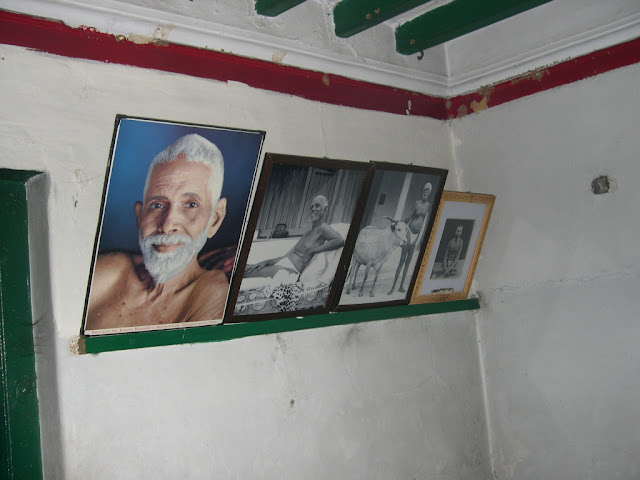
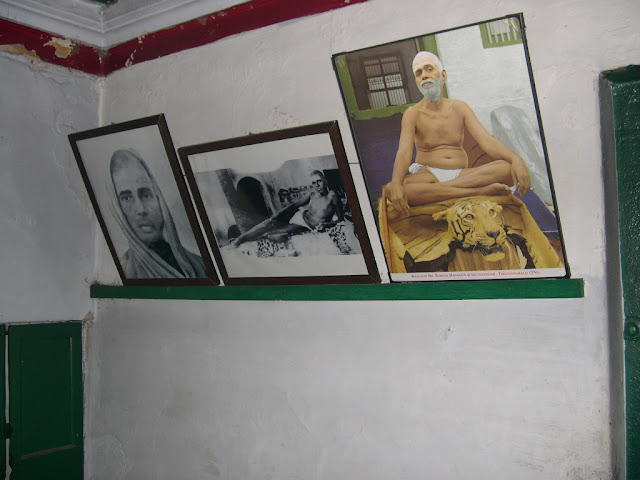
Both photos taken inside Skandasramam, 2006
Prev Next
25th August, 1946
The Europeans whom you sent with a letter of introduction came here by car the day before yesterday. An American lady also came with them. Yesterday morning they went round the town and after visiting Skandasramam, reached the Ashram by midday. After making all arrangements for the return journey they came into the hall by 3 p.m. and sat down. Unaccustomed to squatting on the floor, that poor American lady somehow managed to sit by my side but stretched out her legs towards Bhagavan’s sofa.
I myself felt it unmannerly but kept quiet as she was to go away presently. One of the attendants, Rajagopala Iyer, could not however put up with it and so respectfully suggested to her to sit cross-legged. Bhagavan saw that and said smilingly, “When they find it difficult even to sit down on the floor, should you force them to sit cross-legged also?” “No, No! As they do not know that it is disrespectful to stretch their legs towards Bhagavan, I merely told them so, that is all,” said the devotee. “Oh, is that so? It is disrespectful, is it? Then it is disrespectful for me to stretch my legs towards them. What you say applies to me as well.” Saying that in a lighter vein, Bhagavan sat up cross-legged. All of us laughed but we felt a bit troubled in our minds. Those foreigners stayed there for about half an hour and then went away, taking leave of Bhagavan.
Bhagavan spent the whole of yesterday stretching out his legs from time to time and then folding them, saying that it might be deemed disrespectful. His legs get stiff in ten minutes if he folds them and the stiffness will not disappear unless the legs are stretched out for at least half an hour afterwards, not to speak of the pain that results.
This afternoon when I went into the hall, there were not more than two or three persons there. Bhagavan began stretching his legs saying, “I do not know if I can stretch them. They say it is not good manners.” Poor Rajagopala Iyer was standing there crestfallen and with a repentant look.
Bhagavan is, after all, full of compassion! He stretched out his legs as usual. We all felt happy. Looking at me seated in the hall, he began telling us the story of Avvaiyar.
“Seeing that Sundaramurthi was going away on a white elephant which had come from Kailas, the Rajah of Chera whispered in the ear of his horse the panchakshari mantra and got upon it to go to Kailas. Avvaiyar, who was at the time doing puja to Lord Ganesar, saw them both going to Kailas and so tried to hurry up her puja as she too wanted to go to Kailas. Seeing that, Ganesar said, ‘Old woman, don’t hurry.
Let your puja be performed as usual. I shall take you to Kailas before they reach it.’ Accordingly, the puja was performed in due course. Waving his hand around, he said, ‘Old lady, close your eyes.’ That was all. When she opened her eyes, she found herself seated in Kailas in front of Parvati and Parameswara. By the time Sundaramurthi and Chera Rajah reached the place, they found her already seated there.
Surprised at that, they asked her how she had gotten there.
She told them how Lord Ganesar helped her. They were overjoyed to hear how her bhakti was rewarded ultimately.
She was very old and so she sat opposite to Parameswara with her legs stretched out like me. Parvati could not bear that sight. She was worried because to sit with legs thus stretched out towards Swami, she felt, was a great insult. She respectfully suggested to Parameswara that she should be permitted to tell the old lady about it. ‘Oh, don’t speak, don’t open your mouth. We should not say anything to her,’ said Ishwara. Even so, is not Parvati His better half? How could She put up with that insult? She therefore whispered into the ear of her maid to tell the old lady about it. That woman approached the old lady and said, ‘Grandma, Grandma, don’t keep your legs outstretched towards Ishwara.’ ‘Is that so? Tell me on which side Ishwara is not present. Shall I turn this side?’ said Avvaiyar. So saying, she turned her outstretched legs to another side when Ishwara got turned that side; and when again she turned to a different side, He also got turned the same side. Thus Swami got turned to whichever side she turned her legs. Looking at Parvati, Ishwara said, ‘Do you see now? You would not listen to me. See, how she turns me this side and that. That is why I told you not to open your mouth.’ Then Parvati requested the old lady to excuse her. It is similar to that when people are asked not to stretch their legs towards Swami. Where is He not present?” That devotee then said, “There is a similar incident in the story of Namadeva, is it not?” “Yes, that is so,” said Bhagavan and began relating that story thus: “Namadeva used to pride himself on the fact that Vittal was always more fond of him than others and so once Jnanadeva and others took him to the house of Gorakumbhar for a feast. After food, all of them sat in a row and, during conversation, one of them said in an allegorical manner to Gorakumbhar, ‘You are used to making good pots, aren’t you? Now tell us which amongst these pots are good and which are bad?’ Gorakumbhar thereupon took a potter’s testing rod and began hitting them on the head, one by one.
“They all kept quiet out of regard for him and just kept their heads bent. When it came to the turn of Namadeva, he expressed his resentment at the procedure and refused to undergo the test. Kumbhar forthwith declared that that was an immature pot. All the others burst into laughter at that.
Poor Namadeva could not contain his anger. He began saying that they all had conspired together to humiliate him thus and went to Vittal with tears in his eyes to complain. ‘Well, what is the matter?’ asked Swami, and Namadeva related the whole story. ‘That is all right; but tell me what did the others say when they were tested?’ asked Swami.
Namadeva: They all shut their mouths and bowed when tested with the rod.
Vittal: And you? Namadeva: Am I like them? How intimate I am with you! Am I to be beaten like that for a test? Vittal: That is called ahankara (ego). All of them knew my real Self and had a contented mind. You are not so.
Namadeva: But you are kind to me; and what more is there for me to know? Vittal: That is not it. You must serve elders if you want to know the truth. What am I? If you dance, I dance. If you laugh, I laugh. If you jump, I jump. If you find out the truth, you will not have these jumpings and bumpings.
Namadeva: You say, elders. Who is there older than you? Vittal: Who? There is a temple in the nearby forest.
In that temple there is a sadhu. Go to him and you will realise the truth.
“When Namadeva went to that temple in the forest, he saw an unkempt man lying there. ‘How could this man be a sadhu?’ he thought and, when he went closer to that person, he found the legs of the man on a linga. Shuddering at the sight, he said with trepidation, ‘Sir, what is this? You are putting your legs on the head of God!’ That man said, ‘Oho! Nama, is that you? Vittal sent you, didn’t he?’ Taken aback at this and wondering how the sadhu could know about him, he asked again, ‘Sir, you are a sadhu, aren’t you? How could you put your legs on a linga?’ ‘Is that so, my dear son? I don’t know all that. I am unable to lift my legs. Will you please lift them for me and move them away from the linga?’ he said. Namadeva, agreeing to do so, lifted them and tried to put them elsewhere but found that there was another linga there also. Thus wherever he tried to put the legs, he found a linga there and so finally, he placed them on himself, when he himself became a linga. That is to say, by the touch of those holy feet, he had jnanodaya (dawn of knowledge of the Self). Namadeva stood up dazed. The sadhu asked, ‘Yes, do you now realise (the truth)?’ Saying, ‘Yes, I have realised,’ he bowed before Visobakesar, disciple of Jnaneswar, went home, sat in his room and got immersed in dhyana and stopped going to Vittal.
“After some days, Vittal came there running and asked him, ‘Nama, how is it you haven’t been coming to me of late?’, when Namadev said, ‘Oh, Prabhu (Lord)! Where is the place in which you are not present? I see you here at all times. I am you and you are me. That is why I do not go to you.’ ‘Oh, I see, that is good,’ so saying Vittal vanished.” Bhagavan concluded the story and simultaneously released the legs that were kept crossed.
Both photos taken inside Skandasramam, 2006
Subscribe to:
Posts (Atom)