(125) FORCED DINNERS
Prev Next
27th June, 1947
This afternoon at 3 o’clock, a devotee from Eesanya Mutt came and bowed before Bhagavan. Seeing him, Bhagavan said, “A telegram has been received that the Swami in Kovilur Mutt is no more. Is Natesa Swami gone?”
“Yes. Two days ago. We knew beforehand that he was sick,” he said. Someone asked, “Who is Natesa Swami?” “The deceased who passed away at the Kovilur Mutt was originally in charge of the Eesanya Mutt. When the Matadhipathi (head of the mutt) of Kovilur passed away Natesa Swami was taken there and was made the head of that mutt. That is the most important Vedanta mutt this side. Though he was not very learned, he was a good sadhak and so he was chosen. It might have been about twenty years back,” said Bhagavan.
“Is he the same person that made Bhagavan get into a bandy?” I asked.
“No. That was the one who was in the mutt before Natesa Swami. He was not like this person. He was a powerful personality,” said Bhagavan. “When was that?” someone asked. “That was when I was still in Virupaksha Cave and about four or five years after I came to Tiruvannamalai. It is a funny story. One day when Palaniswamy and myself went round the hill and came near the temple it was 8 p.m. As we were tired, I lay down in Subrahmanya temple. Palani went out to fetch food from the choultry. He (the head of the mutt) was going into the temple. As usual there were a number of disciples around him. One of them saw me and told them about it. That was enough. While returning, he came with ten of his disciples and stood around me. He began saying, ‘Get up, Swami. We shall go.’ I was in mouna then, so I showed by signs that I wouldn’t accompany them. Was he the man to listen to me? ‘Lift him up bodily, lift,’ he said to his disciples.
As there was no alternative, I got up. When I came out, there was a bandy ready. ‘Get in, Swami,’ he said. I declined and showed them by signs that I would prefer to walk and suggested that he should get into the bandy. He took no notice of my protestations. Instead, he told his disciples, ‘What are you looking at? Lift Swami and put him in the cart.’ There were ten of them and I was alone. What could I do? They lifted me bodily and put me into the cart. Without saying anything more, I went to the mutt. He had a big leaf spread out for me, filled it with food of all kinds, showed great respect and began saying ‘Please stay here always.’ Palaniswami went to the temple, enquired about me and then came to the mutt.
After he came, I somehow managed to escape from there.
That was the only occasion on which I got into a cart after coming to Tiruvannamalai. Subsequently whenever new people arrived they sent a cart, asking me to go over to their place. If once I yielded, I was afraid there would be no end to that sort of invitation and so I sent back the cart, refusing to go. Eventually they stopped sending carts. But that was not the only trouble with them. Even if I did not go to them when invited, I used to go round the hill and would sometimes visit the mutt. He would then go in and say something to the cook. At meal time he would have a big leaf spread out for me, sit by my side and instruct the cook to serve me food over and over again. On other days he would not eat along with the disciples in the mutt. but when I visited the mutt he used to sit by my side for food. How could I eat all that was piled on the leaf? I used to touch a little of the various preparations. The balance used to be mixed together by the disciples and the inmates used to eat it saying, ‘It is Swami’s prasadam.’ Noticing that, I gave up eating from a leaf.
Whenever I felt like eating there in the mutt, I used to stay in Pachiamman Koil or somewhere nearby, go to the mutt soon after the naivedya bell was rung, stay near the main entrance and ask for the nivedana (food offering to God). They used to bring it, and give it into my hands. I used to eat without the aid of a leaf. Salt is not put into that nivedana, as it is a Siva temple. Even so, I didn’t mind it at all. All that I wanted was to satisfy my hunger. As the head of the mutt was staying upstairs, he knew nothing about it for some time. One day he saw it accidentally. ‘Who is it that is giving Swami food without salt?’ he enquired angrily.
Subsequently he learned all the facts and left the matter at that. The person who died recently was not like that. He was a very peaceful and easy-going man. He used to sit by my side along with all the others and arrange for serving me food in normal quantities, similar to the others.” “Bhagavan also once lectured there, didn’t he?” someone asked. “Yes,” he replied. “When the person who recently passed away was teaching some lessons to the inmates of the mutt, I happened to go there. They received me with great respect and made me sit down. ‘Go on with the lessons,’ I said. ‘Can I teach lessons in Swami’s presence? Swami himself must say something,’ he replied. So saying, he got a copy of Gita Saram, made his sishyas to read and requested me to explain it. As there was no way out, I gave a discourse.” “Ramachandra Iyer’s grandfather once took Bhagavan to his place, it seems,” said that questioner. “That was long back, perhaps in 1896. I was then at Gopura Subrahmanyeswara Temple. He used to come to me daily, sit for a while and then go. I was in Mouna. So there was no talk or consultation.
Even then he had great devotion. One day it seems he invited someone to his house for a feast. In the noon, before meal time, he came to me with another person. One standing on either side of me they said, ‘Swami, get up. Let us go.’ ‘Why?’ I enquired by signs. They told me the purpose. I refused.
But would they go? They caught hold of my hands and forcibly pulled me up. They were prepared even to carry me in their arms. He was tall, stout and with a big belly. I was at the time lean and weak. I was nothing before him.
His friend was even sturdier. What could I do? I was afraid they might even carry me in their arms if I resisted any further. I knew they were inviting me with great bhakti. So, thinking it was no use arguing with them I walked with them.
From the main entrance they took me into the hall with great respect, spread a big plantain leaf and fed me sumptuously and then sent me back. That is the only family house here where I have eaten on a leaf.”
Showing posts with label early days. Show all posts
Showing posts with label early days. Show all posts

Letter 97
(97) BIRTH
Prev Next
24th February, 1947
Yesterday a lady devotee showed Bhagavan her notebook in which she had copied out the five verses of “Ekatma Panchakam”. Bhagavan saw in that notebook two verses composed by him for his devotees when they first started celebrating his birthday, and told us the following incident:

“On one of my birthdays while I was in Virupaksha Cave, probably in 1912, those around me insisted on cooking food and eating it there as a celebration of the occasion. I tried to dissuade them, but they rebelled saying, ‘What harm does it do to Swamiji if we cook our food and eat it here?’ I therefore left it at that. Immediately after that they purchased some vessels. Those vessels are still here. What began as a small function has resulted in all this paraphernalia and pomp. Everything must take its own course and will not stop at our request. I told them at great length, but they did not listen. When the cooking and eating were over, Iswaraswamy who used to be with me in those days, said, ‘Swamiji! this is your birthday. Please compose two verses and I too will compose two.’ It was then that I composed these two verses which I find in the notebook here. They run as follows:
“This is the purport of those verses. It appears that it is a custom amongst a certain section of people in Malabar to weep when a child is born in the house and celebrate a death with pomp. Really one should lament having left one’s real state, and taken birth again in this world, and not celebrate it as a festive occasion.”
I asked, “But what did Iswaraswamy write?”
“Oh! He! He wrote, praising me as an Avatar (incarnation of God) and all that. That was a pastime with him in those days. He used to compose one verse and in return I used to compose one, and so on. We wrote many verses, but nobody took the trouble to preserve them. Most of the time we two were alone in those days; there were no facilities for food etc. Who would stay? Nowadays as all facilities are provided, many people gather around me and sit here. But what was there in those days? If any visitors came, they used to stay for a little while, and then go away. That was all.” On my request to give me a Telugu translation of those birthday verses, he wrote one and gave it to me.
Prev Next
24th February, 1947
Yesterday a lady devotee showed Bhagavan her notebook in which she had copied out the five verses of “Ekatma Panchakam”. Bhagavan saw in that notebook two verses composed by him for his devotees when they first started celebrating his birthday, and told us the following incident:

Photo (c) Sri Ramanasramam
“On one of my birthdays while I was in Virupaksha Cave, probably in 1912, those around me insisted on cooking food and eating it there as a celebration of the occasion. I tried to dissuade them, but they rebelled saying, ‘What harm does it do to Swamiji if we cook our food and eat it here?’ I therefore left it at that. Immediately after that they purchased some vessels. Those vessels are still here. What began as a small function has resulted in all this paraphernalia and pomp. Everything must take its own course and will not stop at our request. I told them at great length, but they did not listen. When the cooking and eating were over, Iswaraswamy who used to be with me in those days, said, ‘Swamiji! this is your birthday. Please compose two verses and I too will compose two.’ It was then that I composed these two verses which I find in the notebook here. They run as follows:
1. You who intend to celebrate the birthday, first ascertain as to whence you were born. The day that we attain a place in that everlasting life which is beyond the reach of births and deaths is our real birthday.
2. Even on these birthdays that occur once a year, we ought to lament that we have got this body and fallen into this world. Instead we celebrate the event with a feast. To rejoice over it is like decorating a corpse. Wisdom consists in realising the Self and in getting absorbed therein.
“This is the purport of those verses. It appears that it is a custom amongst a certain section of people in Malabar to weep when a child is born in the house and celebrate a death with pomp. Really one should lament having left one’s real state, and taken birth again in this world, and not celebrate it as a festive occasion.”
I asked, “But what did Iswaraswamy write?”
“Oh! He! He wrote, praising me as an Avatar (incarnation of God) and all that. That was a pastime with him in those days. He used to compose one verse and in return I used to compose one, and so on. We wrote many verses, but nobody took the trouble to preserve them. Most of the time we two were alone in those days; there were no facilities for food etc. Who would stay? Nowadays as all facilities are provided, many people gather around me and sit here. But what was there in those days? If any visitors came, they used to stay for a little while, and then go away. That was all.” On my request to give me a Telugu translation of those birthday verses, he wrote one and gave it to me.
Letter 94

(94) HRIDAYAM – SAHASRARAM
Prev Next
13th February, 1947
As verses written by Bhagavan in Tamil on different occasions are found scattered in different notebooks, we have been thinking for a long time past that they should all be collected together in one book, but somehow we have delayed the matter. Four or five days back I told Niranjanananda Swami about this, brought a notebook and began copying them enthusiastically, though my knowledge of Tamil is very limited.
When I asked Bhagavan in what books they are to be found, he said, “They must be in those big notebooks bearing numbers one, two and three. Please see,” and again, “Whenever anyone asked me, I used to write them out on small bits of paper and give them to them. They used to take them away. Some of them were noted down in these books and some were not. If all of them were here, there would by now have been a quite a lot. I wrote many more while l was on the hill. Some of them were thrown away. Who had the desire or the patience to preserve them? If you want them, you may gather them now.”

I felt pained that the Divine voice expressed in verses had not been preserved for future generations and had thus been wasted. I took up volume one, and found verses under the heading, “Bhagavan’s Compositions.” I asked him what those verses were and he replied: “When I was in Virupaksha Cave, Nayana came there once with a boy named Arunachala. He had studied up to the school’s final class. While Nayana and I were talking, the boy sat in a bush nearby. He somehow listened to our conversation and composed nine verses in English, giving the gist of what we were talking about. The verses were good and so I translated them into Tamil verses in ahaval metre.
They read like Telugu dwipada metre. The substance of the verses is as follows:
From the sun of Bhagavan’s face, the rays of his words start out and bestow glow and strength on the moon of Ganapathy Sastry’s (Nayana’s) face which in turn lights the faces of people like us.
“One thing more. Ganapathy Sastry used to say that Sahasrara is the source and the centre of all. The Heart is the support of Sahasrara, is it not? The Heart bestows light on the Sahasrara. I used to say that the Heart is the source of all and that the force that emerges out of the Heart shines in the Sahasrara. To include this idea, the verse suggests a double meaning that the Heart is the sun, the solar orb, and the Sahasrara is the moon.”
Letter 80
(80) ANECDOTES REGARDING LIFE AT VIRUPAKSHA CAVE
Prev Next
25th January, 1947
Vasudeva Sastry who used to look after the routine work while Bhagavan was in Virupaksha Cave, came to the Ashram the other day and sat down in the presence of Bhagavan.
After the preliminary enquiries about his welfare, Bhagavan told us that it was this Sastry who started the Jayanthi celebrations. A devotee asked, “Is he the person who got frightened, and hid himself when a tiger appeared?” “Yes.
It is he,” Bhagavan replied. “During our stay in Virupaksha Cave, we were all seated on the front verandah one night when a tiger appeared in the valley below. We put a lantern outside the railings of the verandah as we thought that the tiger would not approach us because of the light. Sastry however was very afraid. He therefore crept into the cave and asked us also to do likewise; but we refused. After entering the cave, he bolted the iron-barred door and from there tried to frighten the tiger, like a great warrior, saying, ‘Look! If you come this way, take care. Take care of what I’ll do. Yes! What do you think! Bhagavan is here! Take care.’ All these heroics were from inside the cave and were like those of Uttarakumara (in the Mahabharata story). The story is, Uttarakumara, son of the ruling king Virata, started out with Arjuna, boasting of his prowess but took to heel when he faced the enemy. Arjuna finally won the battle. The tiger loitered about for a while and then went its own way. Sastry then ventured to come out --- a very brave man indeed,” said Bhagavan.

Sastry took up the thread of the conversation and said, “That was not the only occasion. Another time, in broad daylight, Swamiji and I were seated on a rock outside the cave. In the valley below, a tiger and a leopard were playing with each other and Bhagavan was smiling as he watched the friendly movements of the two animals. I was however in a terrible fright and requested Bhagavan to come into the cave. He was adamant and sat there motionless. As for myself, I sought the shelter of the cave. The two animals played about for a while, looked at Swamiji, in the same way as pets do, and without any fear or expression of anger, went their own way, one going up the hill and the other down. When I came out of the cave and asked, ‘Swamiji, weren’t you afraid when the two animals were playing about so close to you?’ Bhagavan said with a smile, ‘Why have fear? I knew as I saw them that, after a while, one of them would go up the hill and the other down. And they did. If we get frightened and say, ‘Oh! A tiger!’ they will also get frightened and say, ‘Oh! A man!’ and will rush forward to kill us. If we do not have that fear, they too will not have any fear, and will then move about freely and peacefully.” “In spite of all that Bhagavan had said,” Sastry added, “my fear never left me.”
“It was Sastry who embraced me and wept when my heart stopped beating,” said Bhagavan and narrated the incident thus: “One day I went to the tank in front of Pachiamman Koil with Vasu and others for a bath, and we were returning by a short cut, when, as we approached the tortoise rock, I felt tired and giddy and so sat down on the rock. My experience at that time has been recorded in my biography,* as you all know,” said Bhagavan. Taking up the thread of the conversation, Sastry said: “Yes. While all else stood at a distance weeping, I suddenly embraced him. I was a bachelor at the time and had the liberty to do so. No one else used to touch Swami’s body. He was in that state for about ten minutes, I think, and then gained consciousness. I jumped about with joy. ‘Why this weeping? You thought I was dead? If I am to die, will I not tell you beforehand?’ Bhagavan said, consoling us.”
* “Suddenly the view of natural scenery in front of me disappeared and a bright white curtain was drawn across the line of my vision and shut out the view of nature. I could distinctly see the gradual process. At one stage I could see a part of nature clear, and the rest was being covered by the advancing curtain. It was just like drawing a slide across one’s view in the stereoscope. On experiencing this I stopped walking lest I should fall. When it cleared, I walked on. When darkness and a fainting feeling overtook me a second time, I leaned against a rock until it cleared. And again for the third time I felt it safer to sit, so I sat near the rock.
Then the bright white curtain had completely shut out my vision, my head was swimming, and my blood circulation and breathing stopped. The skin turned a livid blue. It was the regular death- like hue and it got darker and darker. Vasudeva Sastri took me in fact to be dead, held me in his embrace and began to weep aloud and lament my death. His body was shivering. I could at that time distinctly feel his clasp and his shivering, hear his lamentation and understand the meaning. I also saw the discolouration of my skin and I felt the stoppage of my heart beat and respiration, and the increased chilliness of the extremities of my body. Yet my usual current of “Self-effulgence” (Atma-sphurana, Self-awareness) was continuing as usual in that state also.
I was not afraid in the least, nor felt any sadness at the condition of my body. I had closed my eyes as soon as I sat near the rock in my usual padmasana posture but was not leaning against it. The body which had no circulation nor respiration maintained that position. This state continued for some ten or fifteen minutes. Then I felt a shock passing suddenly through the body, circulation revived with enormous force, as also respiration; and there was profuse perspiration all over the body from every pore. The colour of life reappeared on the skin. I then opened my eyes, got up casually and said, ‘Let us go.’ We reached Virupaksha Cave without further trouble. That was the only occasion on which both my blood circulation and respiration stopped.” Then the Maharshi added, to correct some wrong accounts that had been obtained currently about the incident, “I did not bring on the fit purposely, nor did I wish to see what this body would look like at death. Nor did I say that I will not leave this body without warning others. It was one of those fits that I used to get occasionally. Only it assumed a very serious aspect in this instance.”
Prev Next
25th January, 1947
Vasudeva Sastry who used to look after the routine work while Bhagavan was in Virupaksha Cave, came to the Ashram the other day and sat down in the presence of Bhagavan.
After the preliminary enquiries about his welfare, Bhagavan told us that it was this Sastry who started the Jayanthi celebrations. A devotee asked, “Is he the person who got frightened, and hid himself when a tiger appeared?” “Yes.
It is he,” Bhagavan replied. “During our stay in Virupaksha Cave, we were all seated on the front verandah one night when a tiger appeared in the valley below. We put a lantern outside the railings of the verandah as we thought that the tiger would not approach us because of the light. Sastry however was very afraid. He therefore crept into the cave and asked us also to do likewise; but we refused. After entering the cave, he bolted the iron-barred door and from there tried to frighten the tiger, like a great warrior, saying, ‘Look! If you come this way, take care. Take care of what I’ll do. Yes! What do you think! Bhagavan is here! Take care.’ All these heroics were from inside the cave and were like those of Uttarakumara (in the Mahabharata story). The story is, Uttarakumara, son of the ruling king Virata, started out with Arjuna, boasting of his prowess but took to heel when he faced the enemy. Arjuna finally won the battle. The tiger loitered about for a while and then went its own way. Sastry then ventured to come out --- a very brave man indeed,” said Bhagavan.

Photo of entrance to Virupaksha Cave, 2006
Sastry took up the thread of the conversation and said, “That was not the only occasion. Another time, in broad daylight, Swamiji and I were seated on a rock outside the cave. In the valley below, a tiger and a leopard were playing with each other and Bhagavan was smiling as he watched the friendly movements of the two animals. I was however in a terrible fright and requested Bhagavan to come into the cave. He was adamant and sat there motionless. As for myself, I sought the shelter of the cave. The two animals played about for a while, looked at Swamiji, in the same way as pets do, and without any fear or expression of anger, went their own way, one going up the hill and the other down. When I came out of the cave and asked, ‘Swamiji, weren’t you afraid when the two animals were playing about so close to you?’ Bhagavan said with a smile, ‘Why have fear? I knew as I saw them that, after a while, one of them would go up the hill and the other down. And they did. If we get frightened and say, ‘Oh! A tiger!’ they will also get frightened and say, ‘Oh! A man!’ and will rush forward to kill us. If we do not have that fear, they too will not have any fear, and will then move about freely and peacefully.” “In spite of all that Bhagavan had said,” Sastry added, “my fear never left me.”
“It was Sastry who embraced me and wept when my heart stopped beating,” said Bhagavan and narrated the incident thus: “One day I went to the tank in front of Pachiamman Koil with Vasu and others for a bath, and we were returning by a short cut, when, as we approached the tortoise rock, I felt tired and giddy and so sat down on the rock. My experience at that time has been recorded in my biography,* as you all know,” said Bhagavan. Taking up the thread of the conversation, Sastry said: “Yes. While all else stood at a distance weeping, I suddenly embraced him. I was a bachelor at the time and had the liberty to do so. No one else used to touch Swami’s body. He was in that state for about ten minutes, I think, and then gained consciousness. I jumped about with joy. ‘Why this weeping? You thought I was dead? If I am to die, will I not tell you beforehand?’ Bhagavan said, consoling us.”
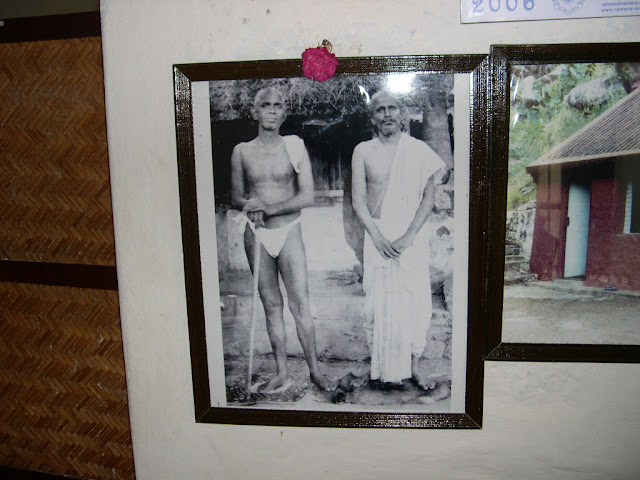
Photo inside Virupaksha Cave of Bhagavan and Ganapathi Muni (taken Feb 2006)
* “Suddenly the view of natural scenery in front of me disappeared and a bright white curtain was drawn across the line of my vision and shut out the view of nature. I could distinctly see the gradual process. At one stage I could see a part of nature clear, and the rest was being covered by the advancing curtain. It was just like drawing a slide across one’s view in the stereoscope. On experiencing this I stopped walking lest I should fall. When it cleared, I walked on. When darkness and a fainting feeling overtook me a second time, I leaned against a rock until it cleared. And again for the third time I felt it safer to sit, so I sat near the rock.
Then the bright white curtain had completely shut out my vision, my head was swimming, and my blood circulation and breathing stopped. The skin turned a livid blue. It was the regular death- like hue and it got darker and darker. Vasudeva Sastri took me in fact to be dead, held me in his embrace and began to weep aloud and lament my death. His body was shivering. I could at that time distinctly feel his clasp and his shivering, hear his lamentation and understand the meaning. I also saw the discolouration of my skin and I felt the stoppage of my heart beat and respiration, and the increased chilliness of the extremities of my body. Yet my usual current of “Self-effulgence” (Atma-sphurana, Self-awareness) was continuing as usual in that state also.
I was not afraid in the least, nor felt any sadness at the condition of my body. I had closed my eyes as soon as I sat near the rock in my usual padmasana posture but was not leaning against it. The body which had no circulation nor respiration maintained that position. This state continued for some ten or fifteen minutes. Then I felt a shock passing suddenly through the body, circulation revived with enormous force, as also respiration; and there was profuse perspiration all over the body from every pore. The colour of life reappeared on the skin. I then opened my eyes, got up casually and said, ‘Let us go.’ We reached Virupaksha Cave without further trouble. That was the only occasion on which both my blood circulation and respiration stopped.” Then the Maharshi added, to correct some wrong accounts that had been obtained currently about the incident, “I did not bring on the fit purposely, nor did I wish to see what this body would look like at death. Nor did I say that I will not leave this body without warning others. It was one of those fits that I used to get occasionally. Only it assumed a very serious aspect in this instance.”
Letter 3
(3) QUARREL BETWEEN UMA AND MAHESWARA
23rd November, 1945
This afternoon, while Viswanath was sitting near Bhagavan along with other devotees, Bhagavan was somehow reminded of an old widow and began to speak about her as follows: (I afterwards learnt that she is the younger sister of Muthu Krishna Bhagavathar who received Sri Bhagavan with kindness and gave him food at Kilur Agraharam.)
“That good lady not only gave me a hearty meal, but also, with a loving heart, gave me a parcel of sweetmeats offered as naivedya (offerings to God) to the household God, saying, ‘My dear boy, keep this with you carefully and eat the sweetmeats on the way.’
She came to see me twice while I was in Virupaksha Cave and used to say, ‘My dear boy, look what a state you are in! Your body is golden and you do not even wrap a cloth round it.’” When he spoke in this strain about her motherly affection, I could see that Bhagavan was overflowing with love.

His voice was choked with emotion. That sight reminded me of the saying that the heart of a Jnani is as soft as butter, and once more of the old saying, “bhakti poornathaya Jnanam” (The culmination of devotion is knowledge).
Sometime back, while reading that portion in Arunachala Purana where Gautama was extolling Amba, Bhagavan’s eyes were flooded with tears, his voice faltered and he put the book aside and sank into silence. Whenever any incident full of love takes place, or whenever passages saturated with bhakti are read, we often see Bhagavan thus overwhelmed with emotion. As one goes on observing, one gets confirmed in the view that prema and bhakti (devotion) are merely different aspects of jnana (knowledge).
About a week ago, a story appeared in the magazine Hindu Sundari under the heading “Paachikalu” (dice). It seems it was taken from the Skanda Purana. Once, even Parvati and Parameswara succumbed to the quarrel-mongering of Narada. “Lakshmi and Vishnu play dice, so why not you?” said Narada, and egged them on to play. Parvati was enthusiastic over the idea and persuaded Siva to play dice with her. In the game, Siva lost and Parvati was puffed up with pride and spoke slightingly of him. That is the legend.
After reading it, Bhagavan, his heart full of bhakti, asked me, “Have you read this story?” When I said, “Yes, Bhagavan,” he said with a voice choked with feeling, “The holy festival which is annually performed here on Sankaranti day, deals mainly with this quarrel between Uma and Maheswara.”
You know, every year, the divine marriage festival is celebrated here and during those days, if anybody were to speak about the festival in Sri Bhagavan’s presence, Bhagavan would usually remark with great feeling, “This is the marriage festival of Father and Mother.” You know the lives of Mahatmas are full of peculiar incidents. They express in their faces whatever rasa (feeling) is appropriate to the occasion. But what can one say in the presence of the all pervading vijnana rasa which integrates all the other rasas?
23rd November, 1945
This afternoon, while Viswanath was sitting near Bhagavan along with other devotees, Bhagavan was somehow reminded of an old widow and began to speak about her as follows: (I afterwards learnt that she is the younger sister of Muthu Krishna Bhagavathar who received Sri Bhagavan with kindness and gave him food at Kilur Agraharam.)
“That good lady not only gave me a hearty meal, but also, with a loving heart, gave me a parcel of sweetmeats offered as naivedya (offerings to God) to the household God, saying, ‘My dear boy, keep this with you carefully and eat the sweetmeats on the way.’
She came to see me twice while I was in Virupaksha Cave and used to say, ‘My dear boy, look what a state you are in! Your body is golden and you do not even wrap a cloth round it.’” When he spoke in this strain about her motherly affection, I could see that Bhagavan was overflowing with love.

His voice was choked with emotion. That sight reminded me of the saying that the heart of a Jnani is as soft as butter, and once more of the old saying, “bhakti poornathaya Jnanam” (The culmination of devotion is knowledge).
Sometime back, while reading that portion in Arunachala Purana where Gautama was extolling Amba, Bhagavan’s eyes were flooded with tears, his voice faltered and he put the book aside and sank into silence. Whenever any incident full of love takes place, or whenever passages saturated with bhakti are read, we often see Bhagavan thus overwhelmed with emotion. As one goes on observing, one gets confirmed in the view that prema and bhakti (devotion) are merely different aspects of jnana (knowledge).
About a week ago, a story appeared in the magazine Hindu Sundari under the heading “Paachikalu” (dice). It seems it was taken from the Skanda Purana. Once, even Parvati and Parameswara succumbed to the quarrel-mongering of Narada. “Lakshmi and Vishnu play dice, so why not you?” said Narada, and egged them on to play. Parvati was enthusiastic over the idea and persuaded Siva to play dice with her. In the game, Siva lost and Parvati was puffed up with pride and spoke slightingly of him. That is the legend.
After reading it, Bhagavan, his heart full of bhakti, asked me, “Have you read this story?” When I said, “Yes, Bhagavan,” he said with a voice choked with feeling, “The holy festival which is annually performed here on Sankaranti day, deals mainly with this quarrel between Uma and Maheswara.”
You know, every year, the divine marriage festival is celebrated here and during those days, if anybody were to speak about the festival in Sri Bhagavan’s presence, Bhagavan would usually remark with great feeling, “This is the marriage festival of Father and Mother.” You know the lives of Mahatmas are full of peculiar incidents. They express in their faces whatever rasa (feeling) is appropriate to the occasion. But what can one say in the presence of the all pervading vijnana rasa which integrates all the other rasas?
Subscribe to:
Posts (Atom)