28th October, 1947
(154) VAIRAGYA, BODHA, UPARATI (NON–ATTACHMENT, ILLUMINATION, DESIRELESSNESS)
I have recently been reading the Vasudeva Mananam.
Yesterday I read in the chapter of “Vairagyabodhoparati” that, if Realization be attained, then liberation, (moksha) can be gained even without vairagya (non-attachment) and uparati (desirelessness). I asked Bhagavan Ramana how that could be, as according to the Ancients, the sign of a Realized Soul (Jnani) is non-attachment.
Bhagavan replied, “It is true that non-attachment is the sign of a Realized Soul. But it is also stated in the same book that any apparent attachment one may be conscious of pertains to the body only and not to the Self. That attachment is a deterrent to the complete happiness of a jivan mukta, i.e., of one delivered from worldly bonds during his lifetime; whereas for the videha mukta (one who is delivered from worldly bonds only at death), Realization alone is important.
When it is stated that liberation can be gained by obtaining realization even without non-attachment and desirelessness, it means that liberation is gained only at the time of death. It cannot be said, however, that it will all be of waste if one has non-attachment and desirelessness yet no realization, for they will enable one to attain heaven (punyaloka). It is all mentioned in Vasudeva Mananam.”
I then asked how realization could ever be attained without non-attachment and desirelessness.
Bhagavan Ramana explained, “Non-attachment, Illumination and desirelessness (vairagya, bhodha, uparati), these three, will not remain separate from one another. After attaining realization though one may continue outwardly to show attachment, inwardly non-attachment will necessarily be there. It is however said to be a hindrance to the complete enjoyment of bliss by a jivan mukta. Owing to the strength of the results of past actions (prarabdha), he acts as one having inherent tendencies (vasanas); but, strictly speaking, attachment will not touch him. That is why it is said to be the result of past actions.”
I asked whether that meant that, even though one attained knowledge of the Self, one would not be able, were past actions to remain too strong, to discard inherent tendencies, and that, until those inherent tendencies were destroyed, one could not attain undisturbed peace.
Bhagavan replied, “Yes, those who are firm in their vairagya, bodha and uparati are indeed in a high state of realisation, that means they are jivan muktas. If instead those for whom Self-realisation alone is the most important, but out of prarabdha they move about as if they have attachments, they remain conscious of the fact that they actually do not have attachments. Strictly speaking such attachments do not affect them. That is why in Vasishtam it is said that even in the third stage, vasanas get exterminated and the mind gets destroyed. If it is asked when the fourth stage is reached and where is the need for the fifth and the sixth stage, some vague replies are given. So long as there is a doubt, there is an explanation. The disappearance of all doubts is realisation.”
“For a Realized Soul,” I asked, “to the extent to which he has non-attachment, will he to that extent have tranquillity and peace; while to the extent that his attachment grows, will he to that extent be further removed from tranquillity?”
“Yes,” said Bhagavan, “that is the meaning.” And so saying, he was again silent.
Showing posts with label Vasishtam. Show all posts
Showing posts with label Vasishtam. Show all posts

Letter 123
(123) KARATHALA BHIKSHA (ALMS IN THE PALMS)
Prev Next
20th June, 1947
Four or five days back, a notebook of Madhavaswami was found. As Bhagavan was looking into it, he saw a Tamil verse in it written by him, long ago. It was in Malayalam script, and while transcribing it into Tamil he told us its meaning:
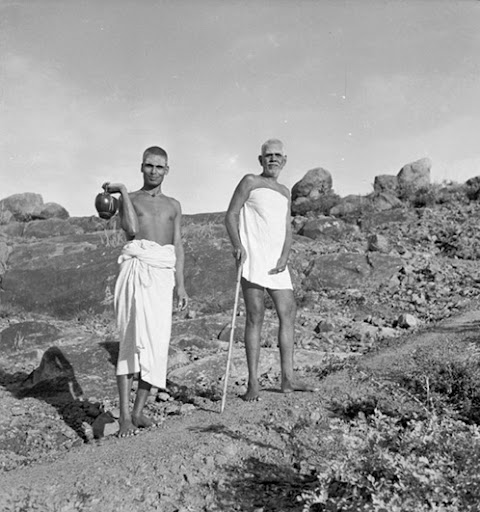 Madhavaswami with Bhagavan Ramana
One devotee asked, “For what reason did Bhagavan write this verse?”
“In Tamil, in a book called Prabhulingalila, the same idea was expressed in a verse of four lines, and so, seeing it I thought it better to write briefly in a smaller verse of two lines,” said Bhagavan. He then wrote it in Tamil script and began telling us further as follows: “The symbol of the used leaf has been given by many people. However nicely a leaf-plate is stitched, it is useful only until the meal is over.
After that will there be any regard for it? It is immediately thrown away. Rich people have food on silver plates with gold flowers inlaid in them. Why are such things required when we have hands given by God? “When I was on the hill someone got a leaf plate made of silver and requested me to eat from it. I sent it back saying that I did not require it. When the food can be eaten out of the hands, why silver and gold? For a long time I did not eat food from a leaf. If anybody brought food, I used to stretch out the palms of my hands and when the food was put in them I used to eat it. It is only of late that I have begun eating food served on a leaf.”
Another person said, “Is it because of that, that Ganapati Muni praised you saying ‘Karathamarasena supatravata’?” Bhagavan replied “Yes. When you have hands, why all these things? It used to be an exhilarating experience in those days. When I was going out for bhiksha, I used to take the alms in the palms of my hands and go along the street eating it. When the eating was over I used to go on licking my hands. I never used to care for anything. I used to feel shy to ask anyone for anything. Hence that karathala bhiksha (alms in the palms) used to be very interesting. There used to be big pundits this side and that; sometimes big government officials also used to be there. What did I care who was there? It would be humiliating for a poor man to go out for bhiksha, but for one who has conquered the ego and become an Advaiti, it is a great elevation of the mind. At that time, he would not care if an Emperor came there. In that way, when I went out for bhiksha and clapped my hands, people used to say, ‘Swami has come’, and give me bhiksha with fear and devotion.
Those who did not know me used to say, ‘You are strong and sturdy. Instead of going out like this as a beggar, why don’t you go out to work as a cooly?’ I used to feel amused. But I was a Mouna (silent) Swami and did not speak.
I used to laugh and go away feeling that it was usual for ordinary people to talk like that. The more they talked like that the more exhilarated I felt. That was great fun.”
“In Vasishtam, there is a story about Bhagiratha before he brought Ganges down to the earth. He was an Emperor but the empire seemed to him a great obstacle to atmajignasa (Self-enquiry). In accordance with the advice of his Guru and on the pretext of a yagna (sacrifice), he gave away all his wealth and other possessions. No one would, however, take the empire. So he invited the neighbouring King who was an enemy and who was waiting for a suitable opportunity to snatch it away and gifted away the empire to him. The only thing that remained to be done was to leave the country. He left at midnight in disguise, lay in hiding during day time in other countries so as not to be recognised and went about begging alms at night. Ultimately he felt confident that his mind had matured sufficiently to be free from egoism. Then he decided to go to his native place and there went out begging in all the streets. As he was not recognised by anybody, he went one day to the palace itself. The watchman recognised him, made obeisance and informed the then King about it, shivering with fear. The King came in a great hurry and requested him (Bhagiratha) to accept the kingdom back, but Bhagiratha did not agree.
“Will you give me alms or not?” he asked. As there was no other alternative, they gave him alms and he went away highly pleased. Subsequently he became the King of some other country for some reason and when the King of his own country passed away, he ruled that country also at the special request of the people. That story is given in detail in Vasishtam. The kingdom which earlier appeared to him to be a burden did not trouble him later when he became a Jnani. All that I want to say is, how do others know about the happiness of bhiksha? There is nothing great about begging or eating food from a leaf which is thrown out after taking food from it. If an Emperor goes out begging, there is greatness in that bhiksha. Now, bhiksha here means that you must have vada and payasam (pudding).
In some months, there will be several such things. Even for padapuja (worshipping of the feet) money is demanded.
Unless the stipulated money is tendered before hand, they refuse to take upastaranam (a spoonful of water taken with a prayer before beginning to take food). The unique significance of Karathala Bhiksha has now degenerated to this extent,” said Bhagavan.
[* Ed. loincloth/kaupinam]
Prev Next
20th June, 1947
Four or five days back, a notebook of Madhavaswami was found. As Bhagavan was looking into it, he saw a Tamil verse in it written by him, long ago. It was in Malayalam script, and while transcribing it into Tamil he told us its meaning:
This is the essence of what is stated in this verse.”
“When a man attains jnana, he will not have any regard for this body. Just as, after taking food, the leaf on which it was taken is thrown away however nice it may be, so also after attaining jnana one will be waiting eagerly for the time when it can be thrown away.
 Madhavaswami with Bhagavan Ramana
One devotee asked, “For what reason did Bhagavan write this verse?”
“In Tamil, in a book called Prabhulingalila, the same idea was expressed in a verse of four lines, and so, seeing it I thought it better to write briefly in a smaller verse of two lines,” said Bhagavan. He then wrote it in Tamil script and began telling us further as follows: “The symbol of the used leaf has been given by many people. However nicely a leaf-plate is stitched, it is useful only until the meal is over.
After that will there be any regard for it? It is immediately thrown away. Rich people have food on silver plates with gold flowers inlaid in them. Why are such things required when we have hands given by God? “When I was on the hill someone got a leaf plate made of silver and requested me to eat from it. I sent it back saying that I did not require it. When the food can be eaten out of the hands, why silver and gold? For a long time I did not eat food from a leaf. If anybody brought food, I used to stretch out the palms of my hands and when the food was put in them I used to eat it. It is only of late that I have begun eating food served on a leaf.”
Another person said, “Is it because of that, that Ganapati Muni praised you saying ‘Karathamarasena supatravata’?” Bhagavan replied “Yes. When you have hands, why all these things? It used to be an exhilarating experience in those days. When I was going out for bhiksha, I used to take the alms in the palms of my hands and go along the street eating it. When the eating was over I used to go on licking my hands. I never used to care for anything. I used to feel shy to ask anyone for anything. Hence that karathala bhiksha (alms in the palms) used to be very interesting. There used to be big pundits this side and that; sometimes big government officials also used to be there. What did I care who was there? It would be humiliating for a poor man to go out for bhiksha, but for one who has conquered the ego and become an Advaiti, it is a great elevation of the mind. At that time, he would not care if an Emperor came there. In that way, when I went out for bhiksha and clapped my hands, people used to say, ‘Swami has come’, and give me bhiksha with fear and devotion.
Those who did not know me used to say, ‘You are strong and sturdy. Instead of going out like this as a beggar, why don’t you go out to work as a cooly?’ I used to feel amused. But I was a Mouna (silent) Swami and did not speak.
I used to laugh and go away feeling that it was usual for ordinary people to talk like that. The more they talked like that the more exhilarated I felt. That was great fun.”
“In Vasishtam, there is a story about Bhagiratha before he brought Ganges down to the earth. He was an Emperor but the empire seemed to him a great obstacle to atmajignasa (Self-enquiry). In accordance with the advice of his Guru and on the pretext of a yagna (sacrifice), he gave away all his wealth and other possessions. No one would, however, take the empire. So he invited the neighbouring King who was an enemy and who was waiting for a suitable opportunity to snatch it away and gifted away the empire to him. The only thing that remained to be done was to leave the country. He left at midnight in disguise, lay in hiding during day time in other countries so as not to be recognised and went about begging alms at night. Ultimately he felt confident that his mind had matured sufficiently to be free from egoism. Then he decided to go to his native place and there went out begging in all the streets. As he was not recognised by anybody, he went one day to the palace itself. The watchman recognised him, made obeisance and informed the then King about it, shivering with fear. The King came in a great hurry and requested him (Bhagiratha) to accept the kingdom back, but Bhagiratha did not agree.
“Will you give me alms or not?” he asked. As there was no other alternative, they gave him alms and he went away highly pleased. Subsequently he became the King of some other country for some reason and when the King of his own country passed away, he ruled that country also at the special request of the people. That story is given in detail in Vasishtam. The kingdom which earlier appeared to him to be a burden did not trouble him later when he became a Jnani. All that I want to say is, how do others know about the happiness of bhiksha? There is nothing great about begging or eating food from a leaf which is thrown out after taking food from it. If an Emperor goes out begging, there is greatness in that bhiksha. Now, bhiksha here means that you must have vada and payasam (pudding).
In some months, there will be several such things. Even for padapuja (worshipping of the feet) money is demanded.
Unless the stipulated money is tendered before hand, they refuse to take upastaranam (a spoonful of water taken with a prayer before beginning to take food). The unique significance of Karathala Bhiksha has now degenerated to this extent,” said Bhagavan.
Living only under trees, eating food out of their palms, disregarding even the Goddess of Wealth like an old rag, fortunate indeed are those dressed in a codpiece*.
[* Ed. loincloth/kaupinam]
Subscribe to:
Posts (Atom)