Showing posts with label festival. Show all posts

Letter 76

(76) BRAHMOTSAVAM
Prev Next
13th December, 1946
On the 28th day of last month, corresponding to Suddha Panchami in the month of Karthika, the Dhvajarohanam (flag hoisting ceremony) was performed in the temple of Sri Arunachaleswara in connection with the commencement of the Brahmotsava festival. In the evening of the tenth day of that festival the sacred light is lit on the peak of Arunachala mountain. This year that was done on the 7th of this month.

Like the full moon, his face was beaming with smiles and spreading an air of benevolence and happiness to those around him.
During the ten days of the annual festival, the whole town bustles with the crowds of pilgrims that come and go. It is usual for them to come for darshan of Bhagavan. The Deepotsavam (lighting festival) is on the day of Karthika Nakshatra (star). As the crowds begin gathering even four or five days earlier, it is usual for Bhagavan to be seated in the thatched shed in front of the Mathrubhuteswara temple to facilitate darshan to the people. This year however the devotees felt that it would be better to seat Bhagavan in the Golden Jubilee Hall* and so made all necessary arrangements to prevent rain coming in by erecting tatties all around.

(* A thatched shed constructed to the north of the Old Hall in connection with the Golden Jubilee celebrations. )

Bhagavan shifted into the hall three days after the commencement of the Brahmotsavam, a day or two earlier than usual. It was raining heavily. Most of those who came were poor people. And amongst them were the old, the decrepit and women with babies in arms.

As the evening of the tenth day is the festival of the Sacred Light, people who set out on Giri pradakshina (going round the holy mountain) from about 2 a.m. on that day come to the Ashram in groups with wet clothes. To enable them to have darshan without any difficulty Bhagavan used to have one of the doors of the hall closed and the sofa on which he reclined, placed across the door. We thought the same thing should be done now also. “Why?” said Bhagavan.

“It is all right here.” Throughout that night, there was a stormy wind and rain. My timepiece stopped. I therefore got up without knowing the exact time, bathed and sat up thinking of going to the Ashram early. There was no noisy movement of crowds on the road. I thought it was too early and so felt like resting for a while. I fell into a nap. Suddenly I heard the voices of the crowds as in a dream. I got up in confusion. The rain had decreased. Owing to the strong winds the clouds had dispersed. The moonlight was shining in the room through the windows. Feeling that I might be late, I got ready hurriedly and went out only to find that rivulets from the mountain were flowing rapidly making a gurgling noise. The road was a sheet of water. I hastened into the hall and saw the time by the Ashram clock. It was 4-30 a.m. Bhagavan was not to be seen in the hall. When I asked someone where he was, he said, “There, in the shed.” Exclaiming, “In the shed, in this rain and wind!” I went there and saw Bhagavan sitting on the sofa without even a duppatti (sheet of thick cloth) over his body. Like the full moon, his face was beaming with smiles and spreading an air of benevolence and happiness to those around him. The smoke of the scented Agarbathis (incense sticks) filled the whole place with a sweet smell as if it were the perfume of the sandalwood trees of the heavenly Nandavana. The Puranas say that somewhere lies the ocean of milk, that there in that ocean lies the island of Sweta Dwipa, that there in that island Sri Maha Vishnu has His abode and that all the devatas (heavenly beings) surround Him there, offering their homage to Him in enjoyment of bliss and happiness. To me the vast sheet of rain water that surrounded the hall appeared to be the ocean of milk, the Golden Jubilee Hall flooded with electric lights appeared to be the Sweta Dwipa, this Ramana Paramatma seated on the sofa to be Sri Maha Vishnu, and the devotees that surrounded him and offered their homage to be the Devatas. My heart swelled with blissful happiness at that sight.

As I approached Bhagavan with many similar thoughts crowding into my mind, he began to smile. I did not know why. When I bowed before him and got up, he said, “The Vedic recitation is all over.” Two months back, during the Golden Jubilee celebrations, the programme relating to Veda Parayana was gone through an hour earlier than usual and so it was all over when we went there, at the usual time. I thought that the significance of Bhagavan’s smile was that the same thing had happened this time also. Ashamed at my own carelessness, I asked Bhagavan, “Have you been here all night?” Bhagavan replied, “No. Every year people used to come group after group from 2 a.m. onwards. So, I came here at 2 a.m. Because of the rains, they have not come yet.” “You will be fined for having come late,” said one of the devotees to me. We all laughed.

While we were all seated there chatting, Ramaswamy Pillai and Kuppuswamy Iyer came and stood before the sofa.

“Why? Is there any parayana?” asked Bhagavan. “Yes. It is not yet time for a bath. We shall recite Thevaram (Hymns of Lord Siva by three Tamil saints),” said Pillai. Bhagavan agreed and they started to recite. As soon as it was over Ramaswamy came there, saying that it was time for his bath. Pillai said he would recite the Thiruvembavai written by Saint Manikkavachakar.

“It has twenty stanzas. How can I wait till it is all recited? It is time to go,” said Bhagavan, and got ready to go by massaging his legs. “We shall stop presently.” So saying Pillai started reciting one stanza beginning with ‘Annamalaiyan’. The idea contained in it is this:

“Oh! Sakhi (lady companion)! Just as the glitter of the precious stones in the crowns on the heads of the devatas who bow to the lotus feet of Lord Arunachala get dim and hidden by the shining of those lotus feet of the Lord, in the same way the rays of the rising sun dispel darkness (in the universe) and dim the light of the shining stars. At that hour, let us sing the praise of those sacred feet of the Lord. Let us bathe and swim in the tank full of flowers, singing in praise of those lotus feet.”
This recital just ended as Bhagavan placed his feet on the ground to go for his bath. As the recitation ended with the words, “Let us bathe! Get up!” Bhagavan got up from the sofa, saying “Yes! Here I am, getting up for my bath.” We all laughed.

Though the Paramatma who is neither man nor woman manifested Himself in this universe in the shape of Bhagavan, still in the worship of Lord Arunachaleswara, Bhagavan addressed the Lord with abala bhava (feelings of a woman towards her husband). I therefore felt indescribable pride at this. It appears Manikkavachakar sang those songs when he got abala bhava towards the Lord. Bhagavan too wrote his Aksharamanamalai with the same abala bhava. Do you see how exalted a place is accorded to the abala bhava! I started writing to you this series of letters last year just after the festival of Karthika, on the occasion of the arrival of the procession of Lord Arunachala in front of the Ashram while going round the sacred hill (Giri pradakshina) and in the spirit of the Lord’s saying that the child is beholden to the father. All those letters were sent for printing a few days back.

Letter 75

(75) THE GOLDEN JUBILEE CELEBRATIONS
Prev Next
9th September, 1946
In yesterday’s letter, I wrote to you in general about the Golden Jubilee festivities. I am writing to you in this letter a summary of all that was done on that day from 7 a.m. to 7-15 p.m.

The morning programme began at 7-15 a.m. with Uma and other punyasthrees (married ladies) bringing a milk pot, singing bhajans and placing the pot at the feet of Bhagavan.


The grace and the kindness that shine from those eyes pierce through the hearts of all living beings and protect them by giving them the bliss of shanti (peace)


After that, several devotees read essays, songs and verses written by them in Sanskrit, Tamil, Telugu, Kanarese, English and Urdu. This stotra (praise of the Lord) continued with short intervals till about 2 p.m. There were musical concerts by Budalur Krishnamurthy Sastry from 8-30 to 9-30 a.m., rest from 9-45 to 10-00, puja and arati in Mathrubhuteswara Temple from 10-15. At 11 o’clock inmates of the Ashram brought prasadam from Arunachala Temple and placed it before Bhagavan with great devotion. Then there was rest from 11 a.m. to 12 noon.

Devotees requested Bhagavan to take rest as usual till 2 p.m., but would he agree? No sooner had he taken his food, he sat on his sofa as usual. As a number of people had come long distances for his darshan and it was possible they might go away disappointed for want of time, he did not mind his bodily discomfort and out of his abundant love and grace he began giving them darshan without taking his usual rest.

Many people went home thinking that there would not be Bhagavan’s darshan till 2 p.m. When after food I came there, Bhagavan was already sitting on the sofa in the shed, in his resplendent glory, surrounded by all the devotees.

The stotras were being recited one after another. You cannot compare this great Sage with any emperor or god.

That is so because if you go for the darshan of an emperor there will be many impediments, and recommendations are required from many people. As for darshan of the gods, if you go to Vaikuntam, Jaya and Vijaya will be there at the gate and will say that it is not the proper time and ask you to go away. If you go to Kailasa the same thing is done by the pramathaganas (the servants of Siva). Here it is different; there is only one rule. No one should be obstructed from having darshan at any time --- even animals and birds. Who is there equal to this great personification of kindness! He alone is equal to Himself.

In the afternoon from 2 o’clock onwards, people assembled there occupying every inch of space. The volunteers were silently arranging to seat them all comfortably. The Jubilee Hall presented the appearance of the durbar hall of an emperor. At 2 o’clock the Jubilee Souvenir was presented, and after that the brahmin pandits came there with Purna Kumbha (a vessel full of water) reciting Vedas, and thereafter there was the reading of an essay from the Hindi Prachar Sabha. The loud speaker was then installed and addresses were presented in Telugu on behalf of the Arya Vysya Samajam and in Tamil on behalf of Muniswamy Chetty Brothers. After that the lectures began.

The Chairman of the meeting was Sri C. S. Kuppuswami Iyer, a Judge of the Madras High Court. After his opening address in English an essay written by Sir S. Radhakrishnan was read out by Sri T. K. Doraiswamy Iyer. That essay was received just then by post.

After that Swami Rajeswarananda and Dr. T.M.P.Mahadevan spoke in English, Justice Chandrasekhara Iyer spoke in Telugu, M. S. Chellam and Omandur Ramaswami Reddiar, (subsequently he became the Chief Minister of Madras State) in Tamil and K. K. Iravatham Iyer in Malayalam, R. S. Venkatarama Sastry read some prayer slokas and lectured in Sanskrit. Kunjuswami sang some songs. The purport of all those speeches is worth recording but how do I know all those languages to record them? By the time the concluding remarks of the Chairman were made, it was 4-45 p.m. During the period, the Indian Information Bureau representatives took a number of photos with a view to prepare a film of the Golden Jubilee celebrations. And then there was a quarter of an hour’s rest. At 5 p.m. there was a lecture of thanksgiving on behalf of the residents of Tiruvannamalai by Annamalai Pillai, after that a musical concert by Musiri Subrahmania Iyer, then Veda Parayana.

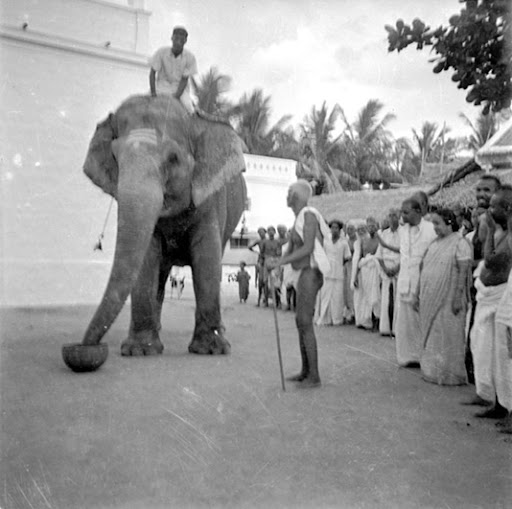
The proceedings came to a close by 7-15 p.m. Before that, at about 6 p.m., the mahout brought the temple elephant fully decorated and made it prostrate before Bhagavan. That elephant is usually kept at the Thousand Pillars Mandapam and it was within that Mandapam in an underground cave that Bhagavan resided during the early days in Arunachaleswara Temple. It was therefore quite appropriate that the elephant staying in that Mandapam should make obeisance to the emperor of that Mandapam.

You may ask what sandesam (message) Bhagavan gave to all those people who came and prostrated before him and prayed for his help and guidance. I wrote a verse in Telugu on that occasion meaning: “He is there as an observer, seeing everything but unaffected, without any gunas (attributes) and as the embodiment of pranava.” In the same manner, he was there without any movement, absorbed in his own Self, seeing and hearing everything but silent all through. That is the great and invaluable message he gave us. The grace and the kindness that shine from those eyes pierce through the hearts of all living beings and protect them by giving them the bliss of shanti (peace). The brilliant tejas (light) of the Mouna Bhaskara (Silent Sun) spreads on all sides, destroys the darkness of ignorance, but that Mouna which is beyond mind and speech --- how could that be broadcast?

Letter 74

(74) THE GOLDEN JUBILEE FESTIVITIES
Prev Next
8th September, 1946
Some friends requested me to write about the festivities connected with the Golden Jubilee that was celebrated on 1st September and so I am writing this letter. In this connection, even the people actively connected with the celebrations do not remember exactly what all was done.

That being so, is it possible for a person of the weaker sex, who is only a mere observer, to know and understand all that was done? I am however venturing to write about it, bearing in mind what is stated by the author of Bhagavatham, when he wrote: “I shall expound to the extent I have seen or known or have heard from men of wisdom.” About twenty days before the date of the celebrations, the Saravadhikari returned from Madras. About a month had elapsed by then, since he had gone to Madurai also. It seems soon after he reached Madras several devotees met and made plans for the celebrations, but until he returned to Tiruvannamalai the preparations for the celebrations were not very much in evidence. I do not know if anyone was working hard elsewhere for the publication of the Souvenir in English but so far as the people in the hall were concerned no one appeared very keen about the celebrations. Only to satisfy the devotees’ request, Bhagavan pretended to rummage old records so as to collect all Sanskrit slokas for translation into English. As soon as the Sarvadhikari arrived, preparations began in right earnest. There is no knowing what deliberations were held in the office or on whose persuasion it was, but they began erecting a big thatched shed adjacent to the hall on the hill side. For the past one month, Krishnaswami had been feeling weak and run down.

However, as soon as the work on the shed was started, his weakness appears to have disappeared and he got enormous strength. He took an active part, climbing up the ladder, stitching the palm leaves together and doing all such work.

The pandal was erected. They said the floor must be cemented. For watering the place, ramming in poles and doing sundry work, he appeared to have got the strength of a giant. It is said that Hanuman was originally sitting quiet like a bird with his tail tucked under him, but when he heard that the ocean had to be crossed, he assumed viswarupa (body of enormous proportions) and did all the work required.

This is an illustration of the saying that God’s devotees get inspired and do all types of work for the good of others when occasion arises.

You remember, you came here about twenty days ago and took away with you the songs and essays of Sri Chinta Dikshitulu and my “Gobbi” song saying you would get them printed before the Golden Jubilee. After that, Muruganar and some other devotees wrote some songs and verses and sent them for printing. The commentary on Sri Ramana Gita written in Sanskrit by Kapali Sastri was received duly printed.

Invitation cards in English with fifty gold stars printed around them were sent out to devotees.

Fifty years ago, a day before Gokulashtami, it seems Bhagavan reached Araiyaninallur. That was a Sunday. On Monday, i.e., on Ashtami day, he had a hearty meal at the house of Muthukrishna Bhagavathar in Kilur and stepped into Arunachala Kshetram, on the morning of Navami, Tuesday. From that day till now, it is a well known fact that he has not moved out of this place. That was the 1st of September, 1896. To enable people in other continents as well to celebrate the event according to the Gregorian calendar, the 1st of September was fixed for the Golden Jubilee celebration.

According to Hindu traditions, the day after Gokulashtami should be deemed to be the day of the Golden Jubilee celebrations. We do not know the ways of Providence but this year too Gokulashtami happened to be on a Monday (19th August 1946). The next day was a Tuesday. According to Tamil traditions, Ramaswami Iyer and others said that that was the day for the celebrations, and so he along with some other devotees wrote some songs and verses in Tamil and recited them. Sri Sambasiva Rao said that according to Telugu traditions, Navami lasted till Wednesday and so the fifty years were completed only on the 21st and, so saying, he wrote an old sloka and a padyam from the Bhagavatham, beginning with, “Nee pada kamala sevayu” (in the service of your lotus feet) and placed it before Bhagavan. Another person composed padyams, songs and essays and began reading them. That Stotra Parayana (recitations of prayers in verse) was continued until two days ago.

The railway strike commenced on the 23rd. We were wondering how the devotees could come here. Some came to Katpadi already on the 29th and somehow managed to come by bus or lorry. On Chathurthi (fourth day of lunar month), puja for Vinayaka was performed in the temple. By the side of the shed, which was named as ‘Jubilee Hall’, a huge pandal was erected which looked very much like a marriage pandal. Some said it would be good if a garland of green leaves was tied around the sofa and decorated.

All the speakers came by bus by 9 o’clock at night. The celebrations are to commence next morning. We discussed them till late into the night and then went to sleep. When we went to the Ashram in the early morning by 5 o’clock as usual, “Na karmana” was already being recited. It seems they started the routine an hour earlier than usual. The Ashram Vidyarthis (students) brought the articles for puja, placed them before Bhagavan and, after bowing before him, took them into the temple. Upbraiding ourselves for our carelessness, we went into the pandal and were surprised to find that it was already beautifully decorated. All around the whole of the shed, a red cloth with folds was tied, along with garlands of green mango leaves, flowers and many other decorative things. Recently the Rani of Baroda sent sarees full of jaree (silver lacing) to decorate the Goddess in the temple. All those sarees were spread over the stone sofa, which was on the northern side of that parnasala (thatched shed) named Jubilee Hall, so as to give it the shape of a mandir. The silver-laced sarees were shining brilliantly because of the lights. When I asked one of the devotees whether the sarees were not meant for decorating the goddess in the temple, he said that that decoration could be done only after decorating Bhagavan’s sofa. Another devotee said that the idea was excellent.

Nothing had been done at nine the previous night. So if by five the next morning all that decoration had been done, we must conclude that the devotees did not sleep at all the whole night. We do not know how other devotees arrived during the night but by morning they were all seated in groups in several places with all their belongings.

Bhagavan finished his bath and breakfast by 6-30 a.m. and went towards Arunachala. By the time he returned, Krishnaswami had already spread over the stone sofa pure khaddar clothes and covered the seat with a newly purchased cloth bearing the picture of the spinning wheel and the tricolour flag. It is no exaggeration to say that it was attractive because of its simplicity and also because the flag is a symbol of our national honour, in the midst of the splendour of the varied decorations. It is interesting to note that it was on a similar day of September that Jawaharlal Nehru became the Prime Minister of India.

By seven o’clock, Bhagavan was sitting on the sofa in his usual loincloth with his radiant smile, to bless his devotees.

His gracious and benevolent look made all the devotees happy. It was indeed a great privilege to see him on that day.

In olden days, Valmiki, Vyasa and other great authors told us how God Himself came down to this world in the shape of Avatars like Rama and Krishna to establish dharma from time to time --- “Dharma samsthapanarthaya sambhavami yuge yuge” (for establishing Dharma, righteousness, on a firm footing, I am born from age to age; Gita IV-8). Today we are lucky in having a similar fortune. An Avatara Purusha, Jagadguru, Sri Ramana Paramatma has been staying in Arunachala Kshetra for the last fifty years and has been purifying the souls of people by his mere looks. To those who serve him with undivided bhakti he can with his silent teaching remove the worldly bonds and give moksha. Our duty is to serve him instead of wasting precious time on trifles.

This Golden Jubilee itself proclaims that for fifty years now he has been occupying the exalted position of a Guru. Many devotees say this is a golden age or a new age. All these days many fortunate people secured his grace, drank the nectar of peace and became blessed ones. Many more are likely to gain his blessings thus. Till now my eyes have not been opened to know in fullness his real greatness. There will be many like me, who do not know how this personification of kindness is giving us various occasions to serve him. Of all these occasions, it occurs to me, this Golden Jubilee is the greatest. Even now, I do not know how to serve this great Sage, how to pray to him and how to worship him. When he who is omnipresent, who is omniscient and who is incomprehensible comes here in human form what can we give him and how could we satisfy him? The real worship of him is to be in mouna (silence). As that type of worship is beyond my reach. I am always staying at a distance, hoping against hope that I may gain salvation by touching the dust of his feet and by satisfying myself with that only. What else is there to wish for except that he should live with us like this for long, giving the benefit of his grace to the true seekers of knowledge and saving their souls by his kindness and blessings.

I shall describe to you in another letter what all had happened from 7 o’clock in the morning to 7-15 at night.

Letter 6

(6) IN SERVICE OF THE SAGE
26th November, 1945
When I went to the Ashram for the early morning Veda Parayana everyone was terribly busy. The kitchen presented a picturesque appearance, some cooking, some cleaning, some giving orders, everyone busy with one thing or another.

Puliyodara, dadhyonnam, pongal, vadai, chips, puries and kootu and ever so many eatables were filled into baskets and sent up the hill. The Sarvadhikari does not appear to have had a wink of sleep the whole night. He is the person who has taken all the trouble.


Lord Krishna is reported to have stopped the celebration of the annual Indra Yajnam performed by the shepherds and instead arranged for the worship of the Govardhana Giri itself.

When you saw the series of baskets going up the hill it appeared as if Sri Ramana had arranged this worship of Arunachala in place of the vana samaradhana of the Amala Tree (garden festival) performed annually during the month of Karthika.

After Veda Parayana, Bhagavan had his bath and breakfast and started for Skandasramam accompanied by Rangaswami, who is like Nandi to Lord Siva. Leading the way, Bhagavan went up the hill to Skandasramam as if he was going to his own home.

Without giving the least inconvenience to Bhagavan the devotees proceeded in several groups and reached Skandasramam. Aunt Alamelu (sister of Bhagavan) and myself followed. Some other women got to the destination a little late. Being surrounded by the devotees Bhagavan was seated comfortably under the pleasant shade of the trees just in front of the Skandasramam building. This showed what a Rishiasramam is generally like. This Ashram was just like Badarikasramam of old as described in Harivamsam though the latter could not now be witnessed direct. This Skandasramam like Badarikasramam provided a visual feast with its water coming out of the rocky fountain, resembling the sandhyarghya jalam (the oblations at dawn and dusk) of Samyameswara and warblings and melodious notes of the birds sounding like the musical hymns of Sama Veda as sung by rishikumaras (the sons of seers). Apart from the many sadhakas and sannyasins present, lawyers and doctors, engineers and artists, newspaper correspondents and poets, songsters and a good many others arrived from Madras, Pondicherry and Villupuram. The young and old, the men and women and all without distinction of high and low, squatted on the ground around Bhagavan looking at him with a fixed gaze. While the Arunagiri abounding in mineral wealth served as the precious jewelled-throne, the clouds adorning the sky served the purpose of Sveta Chhatram (the white Umbrella) and the tree grove with innumerable branches acted as vensamarams (fans used in deity worship).

Sri Bhagavan shone in his glory as an emperor crowned, while Prakritikanta (Nature personified) waved lights to him with its agreeable rays of the sun.

Brother! How can I draw that picture for you? The Maharshi is calm and his serene gaze, coming from the source, pervades all corners. His gentle smile shone like the cool rays of the moon. His words simply rained amrit. We sat there like statues without consciousness of the body. The photographers then attended to their job. After 9-30 a.m. the usual daily programme of the Ashram below, relating to mails, newspapers, etc. was gone through as in a Maharaja’s durbar. The clouds then increased and the wind blew heavily. The devotees gave Bhagavan a shawl with which he covered his whole body except the face. Then Bhagavan, in his sitting posture, looked like his mother Alagamma incarnate. Aunt and myself were of the same opinion. This scene was also photographed.

Sri Bhagavan preached for some time in silence in the “gurosthu mouna vyakhyanam” (the Guru explaining by mere silence) way. There may certainly be some pure-hearted souls that could all become “chhinna samsayah” (cleared of all doubts). But in my case, my mind ran to the preparations like puliyodara and dadhyonnam, etc., as it was lunch time.

The question was whether everything was offered to the hill or anything was left behind. The doubt was solved after 11- 30 in the forenoon. My brethren wished to arrange the delicacies for Bhagavan separately in a comfortable place.

But would he agree to that? He got a table arranged by his sofa and feasted there in the midst of all.

After the meal, his sofa was set up on the verandah, which has an iron-grating enclosure. The devotees were at first at a distance but in a few minutes came near to Bhagavan.

Aunt Alamelu and I with some other women were seated in an adjacent room looking at Bhagavan through a window just opposite to his lotus feet. He then began to talk, telling us short stories about his past life on the mountain, relating the arrival of the mother, the construction of Skandasramam, the water supply, the supply of provisions, the rule of the monkey kingdom, the peacock dances, his association with serpents and leopards. During this discourse he greeted a new entrant, the poet Naganarya, by enquiring, “When did you come?” Turning towards me he observed, “Here he comes.” I replied, “Yes.” Then something was recalled to his mind and he said, fixing his resplendent gaze,
There mother had her nirvana (left her mortal frame). We made her sit there outside. Still no mark of death was visible in her face.
Like one seated in deep samadhi, divine light was seen in a holy dance. There, just there, where you are now sitting.”

His enchanting words entered my ears like the sweet note of the Venu (the divine flute). I stood at this place worth seeking and heard the words worth hearing. What a glorious day is today! Kapila liberated Devayani by initiating her into the Reality. Dhruva put Sunita on the path of salvation. Sri Ramana in his turn not only vouchsafed the eternal empire of freedom and bliss to his revered mother but also did the highest honour by installing the Mathrubhuteswara Lingam on her samadhi to make her glory permanently extolled in the world.

On hearing the word “Mother” from the mouth of Sri Bhagavan, I was overcome with ecstasy and tears filled my eyes. It sounded as though the words about the mother were uttered to the daughter. Mahatmas always honour women. They view woman as the mother and love in perfect form. There is no creation without nature. Before the arrival of the mother there was no cooking in the Ashram. The mother came and gave a hearty meal to the residents. The agnihotra (fire) first instituted by the mother does the cooking even today and fills the bellies of thousands of devotees.

I turned round to see the photo of that revered mother but, being disappointed on finding none, said silently within, “O Mother, that brought glory to womanhood in general! We are blessed!” In the meanwhile various kinds of delicacies were served. Half an hour after we ate them, puri and koottu were given. After helping ourselves we began to go back.

After seeing us all off one after another, Bhagavan came down from the throne of Arunagiri accompanied by his attendants and, walking slowly, reached the Ashram at its foot just as the sun sank behind the mountain on the west. Then the routine programme of Veda Parayana, etc., was gone through as usual.

May the powers of the Mahatma be heard and seen direct.

Listen! Can they be transcribed in true perspective? Is it possible for any one to do it? Let Brahma alone do that job.

Prev Next

Letter 5

(5) ON TO SKANDASRAMAM
25th November, 1945
Tomorrow is the auspicious day fixed for Bhagavan to go to Skandasramam with devotees and hold a feast there.

All the brother and sister devotees residing in and around the Ashram were busy the whole day making a fuss about arrangements for the trip. Bhagavan was however sitting as usual, dignified, calm and unconcerned. If all ask him to go, he may do so; if they say do not go, he will stay away. Is there anything for him to pack up or worry about? The kamandalu (water bowl), the karra (walking stick), the kaupeena (loincloth) and the towel over him are all the things about him. The moment he thinks of it he could get ready to start.

Sankaracharya has described only such sages as “kaupeenavantah khalu bhagyavantah” (he who wears a loincloth is verily the richest). This Ashram, this programme, these devotees and this paraphernalia are all like a drama enacted on the stage for the benefit of others, but does Bhagavan really need them all? Out of his abundant mercy he is in our midst; thus bound down. By a mere wish, could he not go away freely crossing the seven seas? Remember, his staying with us is our special good luck. I shall write to you again about tomorrow’s happenings.

Prev Next